What Happens to the Wood After a Tree Removal? Your Options
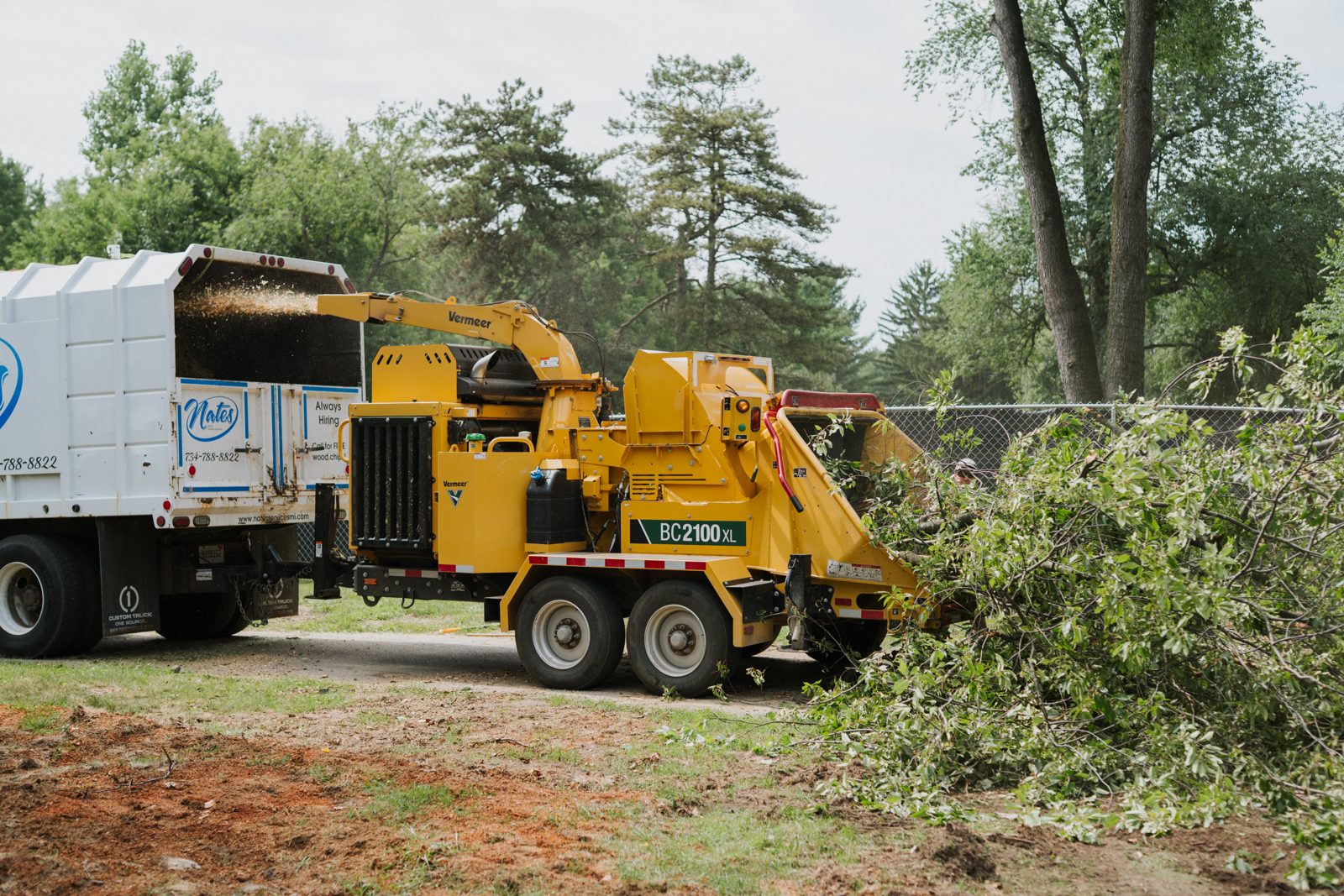
A mature tree turns into a surprising amount of material: brush, limbs, trunk sections, and sometimes a trailer load of chips. At the estimate, most homeowners have not thought about where it all goes, and that decision affects both the price and the day's work. Some people want everything gone. Some want firewood for the next two winters, a pile of free mulch, or a slab from the tree that shaded the house for fifty years. All of those can be reasonable. But Michigan's tree diseases and invasive insects add a few rules about what you should keep, how you should store it, and how far it should travel. Here are the options and the cautions.
— Quick Points —
- Angi's Detroit data lists common debris add-ons at about $70 for hauling, $95 for chipping, and $70 for splitting firewood.
- Fresh arborist wood chips make excellent mulch. WSU Extension recommends keeping them off the trunk and away from planting holes.
- Keep firewood local, and wood from an oak wilt tree should not be stored with bark on unless it is sealed under plastic for a year.
Option 1: Haul It All Away
The simplest option is to have the crew chip the brush and remove the logs. Nothing is left behind except the stump, which can be ground separately. For most suburban lots with no fireplace and no room for a woodpile, this is the right answer.
Some estimates include hauling, and some list it separately. Angi's Detroit tree removal page lists typical add-ons of about $70 for hauling the tree away, an average of $95 for chipping, and about $70 for splitting firewood. Those are averages, not our prices, but they give you a sense of what the pieces are worth. When comparing quotes, make sure you are comparing the same cleanup. A low quote that leaves the logs in the yard may not be a bargain if you then have to pay someone else to remove them.
For larger projects, like clearing several trees, brush, or an overgrown fence line, our land clearing service handles the debris as part of the job.
Option 2: Keep the Wood Chips
Arborist wood chips, the mix of wood, bark, and some leaves that comes out of a chipper, are among the best mulches you can put down, and they are often free. Linda Chalker-Scott, the Washington State University Extension horticulturist who has written extensively on the subject, describes them as excellent for moisture retention, temperature moderation, and weed control. Because they are a mix of particle sizes, they resist compaction better than uniform bagged mulch.
A few common worries do not hold up. WSU Extension notes that fresh chips do not rob established plants of nitrogen. Any nitrogen tie-up happens at the thin layer where the chips meet the soil, which is part of why they suppress weed seeds. Over time, woody mulch actually adds nutrients to the soil. The same work found that chips from diseased trees used as surface mulch do not transmit disease to the roots of healthy trees, and that most wood chips are not allelopathic, black walnut being the well-known exception.
How to use them properly: spread them on top of the soil, never mix them in, and never use them as backfill in a planting hole. WSU's fact sheet suggests about 4 to 6 inches in ornamental beds for weed control, and it is emphatic about keeping chips off trunks. Taper the layer down to almost nothing as you approach the trunk instead of building a mulch volcano, which invites decay and pests. Our landscaping around trees guide has more on mulching around existing trees.
Plan for volume. A full truckload of chips is a lot of material, so tell us how much you actually want and where you want it dumped. A driveway works if you can move the pile in a few days.
Option 3: Keep It for Firewood
If you burn wood, keeping the trunk is an easy win. The crew can cut the rounds to firewood length and stack them or leave them where you choose. Splitting is extra work, whether you pay for it or do it yourself.
Fresh wood is not ready to burn. Illinois Extension recommends getting firewood below 20 percent moisture and says that usually takes at least six to nine months of drying after cutting. Split wood dries much faster than whole rounds. Dense hardwoods like oak are slow, and many wood burners give them a year or more. Stack the split wood off the ground where air can move through it, and, as the University of Kentucky's forestry guidance puts it, cover only the top of the stack and leave the ends open to sun and air. Illinois Extension adds two quick checks: seasoned wood shows small cracks in the ends, and two pieces knocked together make a distinct clink rather than a dull thud.
Some wood makes poor firewood. Kentucky's guidance rates American elm, slippery elm, and sycamore as poor for splitting. You can still burn them, but expect to fight them with a maul.
Keep Firewood Local
This is the part too many people skip. The Michigan DNR's core message on firewood is simple: do not move it. Invasive insects and diseases, including emerald ash borer, oak wilt, and Asian longhorned beetle, travel in firewood. Michigan's invasive species program points out that emerald ash borer adults usually fly only about half a mile on their own. The long jumps happen when people move infested wood.
Emerald ash borer is the cautionary tale. It was first found in Michigan in 2002 and has killed tens of millions of ash trees across the state. Federal quarantines restricting the movement of ash wood and firewood were in place for years before the USDA removed its domestic EAB quarantine regulations in January 2021. The lesson is still valid. Burn firewood near where it was cut. If you are headed to a campground or a cabin, leave your yard wood at home and buy local or certified heat-treated wood there, as the DNR recommends.
A Special Word on Ash
Many of the trees we remove in Southeast Michigan are ash killed or weakened by emerald ash borer. Ash firewood burns well, and there is no reason not to use it at home. Just keep it on your property or very close by. Leftover ash is also a good candidate for chipping, since chips used as mulch are not the concern that moving whole logs with bark is.
If you are keeping wood from a dead ash, keep your expectations modest for anything beyond firewood. Standing dead ash tends to dry out and turn brittle, and the wood just under the bark is often scarred by larval galleries. More about the insect itself is in our guide to tree pests and diseases in Southeast Michigan.
Oak Wilt Wood Needs Special Handling
If the tree came down because of oak wilt, or you suspect it had oak wilt, the wood needs extra care. Oak wilt spreads through root grafts between neighboring oaks and through sap beetles that carry the fungus from infected wood to fresh wounds on healthy trees. The Michigan DNR notes that moving firewood cut from infected trees without debarking it is one of the ways the disease spreads.
The Michigan Oak Wilt Coalition's guidance for homeowners is to chip, burn, debark, or bury wood from infected trees before April 1 of the year after the tree dies. If you want to keep it as firewood, stack it, then cover it and seal the plastic to the ground with 4-mil plastic sheeting for one year to keep insects out while it dries. The DNR adds that once the wood has dried for more than a year, or the bark has loosened all the way around, it can no longer spread oak wilt.
In practice, for most homeowners, the simplest choice with an infected red oak is to have it chipped or hauled. If you do keep it, keep it tarped and sealed and do not give it away or move it off the property.
Milling Logs Into Lumber
People with a large walnut, oak, or maple often ask whether the trunk is worth sawing into boards. Sometimes it is, but be realistic. A study of urban trees in southeastern Lower Michigan published in Arboriculture and Urban Forestry found a meaningful amount of usable saw timber in urban hardwoods. It also noted the familiar problem with yard trees: foreign objects like nails, stones, and even signs grown into the wood, along with rot and defects that make some logs worthless for lumber.
Metal is the biggest issue. Fence wire, clothesline hooks, tree-house bolts, and nails from decades-old signs can ruin a sawmill blade, so many mills are cautious about yard logs, and some will not take them at all. Short trunks, heavy branching, and internal decay reduce the value further. If you want to try it, contact a portable sawmill or urban lumber operation before the removal so we can cut the trunk to the lengths they want. Plan on patience as well, since air-drying thick slabs can take years. For most yard trees, firewood or chips will be the practical outcome.
Burning Brush Yourself
Some rural property owners would rather keep the brush and burn it. Before you plan on that, check the rules. The Michigan Department of Environment, Great Lakes, and Energy notes that state rules prohibit burning yard debris within 1,400 feet of an incorporated city or village limit, and that burning grass and leaves is allowed only in municipalities with fewer than 7,500 residents unless a local ordinance says otherwise. When the ground is not snow-covered, a burn permit is required. In Southern Lower Peninsula counties, including those we serve, permits come from the local fire department or local government rather than the DNR.
Most cities and many townships in our area do not allow open burning at all. Check with your city, township, or fire department first. Even where it is legal, chipping is usually faster, cleaner, and does not bother the neighbors.
Decide Before the Crew Arrives
The easiest removals are the ones where the wood plan is settled at the estimate: what gets hauled, what stays, where firewood gets stacked, and where the chips should go. We walk through all of it with you up front. For what else happens on the day of the work, see what to expect on tree removal day. Free estimates across Livonia and all of Southeast Michigan. Call (734) 788-8822.
— Related Services —
— Keep Reading —