Four Pests Killing Southeast Michigan Trees Right Now
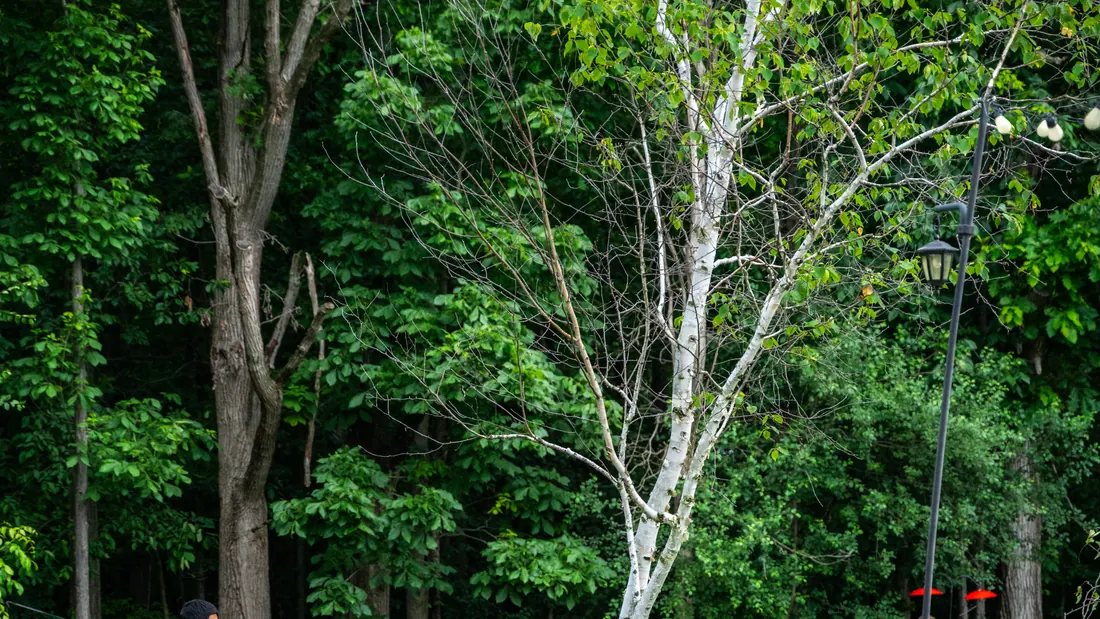
Most of the trees we take down are not old. They are healthy trees that ran into something specific, and in Southeast Michigan there are four things doing most of the damage. Each one has a distinct look, a distinct timeline, and a distinct answer. Knowing which one you are dealing with is the difference between a treatable problem and an expensive removal. Here is what we are actually seeing across Wayne, Oakland, Washtenaw and Livingston counties, and what a homeowner can check this weekend.
— Quick Points —
- Ash trees killed by emerald ash borer get dangerously brittle, and you cannot tell from the ground where they will break.
- Do not prune or wound an oak between April 15 and July 15 — that is Michigan's oak wilt high-risk window.
- Beech leaf disease is confirmed in Wayne, Oakland and Washtenaw counties. Look up through the leaves.
Emerald Ash Borer: The Ones Still Standing
The federal quarantine on emerald ash borer was lifted in January 2021, which some homeowners read as good news. It was not. The quarantine came off because the beetle had spread past the point where movement restrictions helped, not because the threat ended. Michigan no longer even asks residents to report it.
The scale here is hard to overstate. A peer-reviewed study of the Upper Huron River watershed — which covers western Oakland County, southeastern Livingston County and north-central Washtenaw County, essentially our service area — found that by 2009, mortality of green, white and black ash exceeded 99 percent. About 60 percent of those trees died in a four-year window. The state describes tens of millions of ash killed across Michigan.
So the ash on your property is either already dead, or it is one of the survivors. Either way, the standing dead ones are the problem.
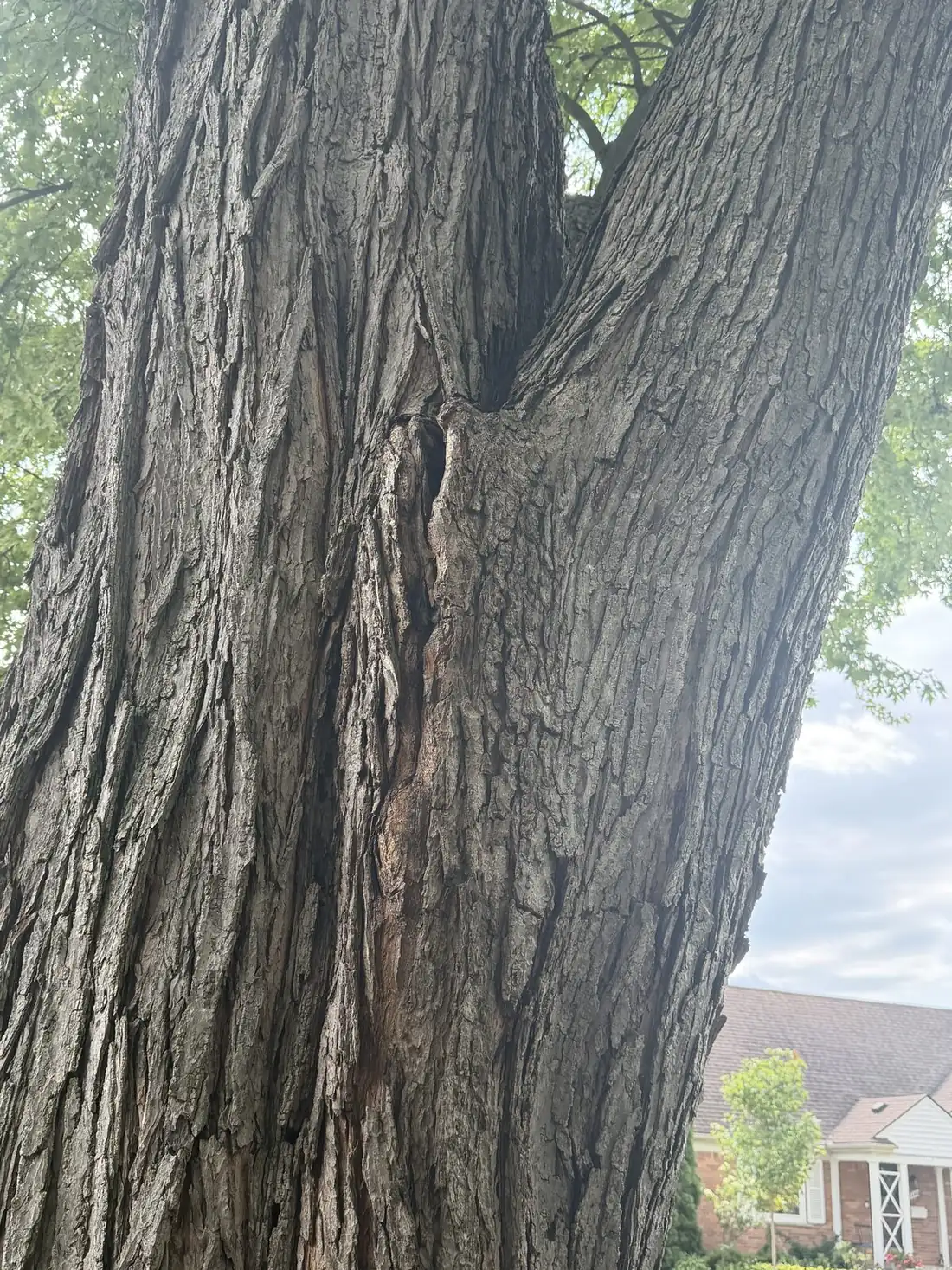
Here is the part that matters for your safety. Ash killed by emerald ash borer dries out and loses structural strength unusually fast, because fungi colonize the beetle galleries and the killed sapwood. Purdue's forestry extension puts it plainly: limbs can break and fall at any point along the branch at any time, and it is not unusual for a sizeable limb to snap thirty feet up on a calm day. Strength loss begins even while the tree still looks two-thirds green.
The Tree Care Industry Association makes the point that should decide this for you: visual inspection is seldom effective at identifying where the decay and strength loss are worst. Nobody — us included — can look at a dead ash and tell you which side will let go. That is why many companies stop climbing ash once the crown is a quarter dead and take them down from a lift or with a crane instead.
If you have a standing dead ash, the honest advice is that waiting makes it more expensive and more dangerous, not less. A tree that could have been climbed last year may need equipment this year.
Oak Wilt: The One With a Calendar
Oak wilt is the disease where timing is everything, and where a homeowner with a chainsaw can cause the problem themselves.
The Michigan DNR is specific: do not prune, trim, or remove oaks between April 15 and July 15. Risk peaks in May and June. During that window, sap-feeding nitidulid beetles are active, they are attracted to fresh wounds, and they carry fungal spores from infected trees directly into the cut. One pruning cut in late May can kill a tree that had nothing wrong with it.
The disease also moves underground. Oaks growing near each other graft their roots together, and the fungus travels through those connections, which is why oak wilt shows up as an expanding circle of dead trees rather than one isolated casualty.
Which oak you have matters. The red oak group — northern red, black, northern pin, the ones with pointed leaf tips — is highly vulnerable and can die within weeks. The white oak group — white, swamp white, bur, the ones with rounded lobes — can be infected but resists spread far better.
What you would see: sudden wilting starting at the top of the tree and working down, with rapid leaf drop. The fallen leaves are the tell — they may be green, brown, or half green and half brown on the same leaf. Symptoms typically appear from late June through September, so right now is when it shows.
Oak wilt is common throughout Michigan's Lower Peninsula, with 62 counties confirmed positive statewide. If you see that pattern, do not wait for spring. And if an oak is wounded during the risk window — storm damage, a lawnmower strike, anything — cover the wound with wound paint or latex paint immediately. This is the one situation where the DNR actually recommends wound paint.
The practical takeaway: schedule oak work for winter, and schedule it early. Good crews book out weeks in advance for dormant-season work.
Beech Leaf Disease: The New One
If you have American beech, look up through the canopy on a bright day with the sun behind the leaves.
Beech leaf disease is caused by a nematode, and the signature symptom is dark, thickened bands or striping between the leaf veins — obvious from below when the leaves are backlit, easy to miss from above. As it progresses, leaves get puckered, curled and distorted, the tree produces fewer leaves and buds, and eventually it defoliates.
Michigan confirmed it in St. Clair County in July 2022 and it moved fast. It is now confirmed in southeast Michigan including Wayne, Oakland and Washtenaw counties. Trees can die within six to ten years of symptoms appearing, and Michigan has roughly 37 million American beech.
There is no simple homeowner cure. What we can do is monitor it, keep the tree as healthy as possible in other respects, and plan ahead rather than react — a beech that declines over several years gives you time to decide, budget, and choose a replacement, which a storm does not.
Worth knowing separately: beech bark disease is a different problem, mostly concentrated in the eastern Upper Peninsula but expanding southward. Its hazard signature is that declining trees can snap in heavy wind before they finish dying.
Spotted Lanternfly: Present, and You Should Squish It
Spotted lanternfly was first identified in Michigan in 2022. As of June 2026, the state has confirmed populations in six counties: Jackson, Lenawee, Macomb, Monroe, Oakland and Wayne.
That distinction matters for what you are asked to do. In those six counties, the state's guidance is to kill it on sight rather than report it — it is established and reporting adds nothing. Everywhere else in Michigan, photograph it and report it through the state's Eyes in the Field system.
It feeds on more than 70 plants, including grape, apple and a range of hardwoods. It rarely kills a mature tree outright, but heavy feeding stresses the tree, and the honeydew it excretes causes sooty mold on everything below — patios, cars, understory plants.
What This Means for Your Property
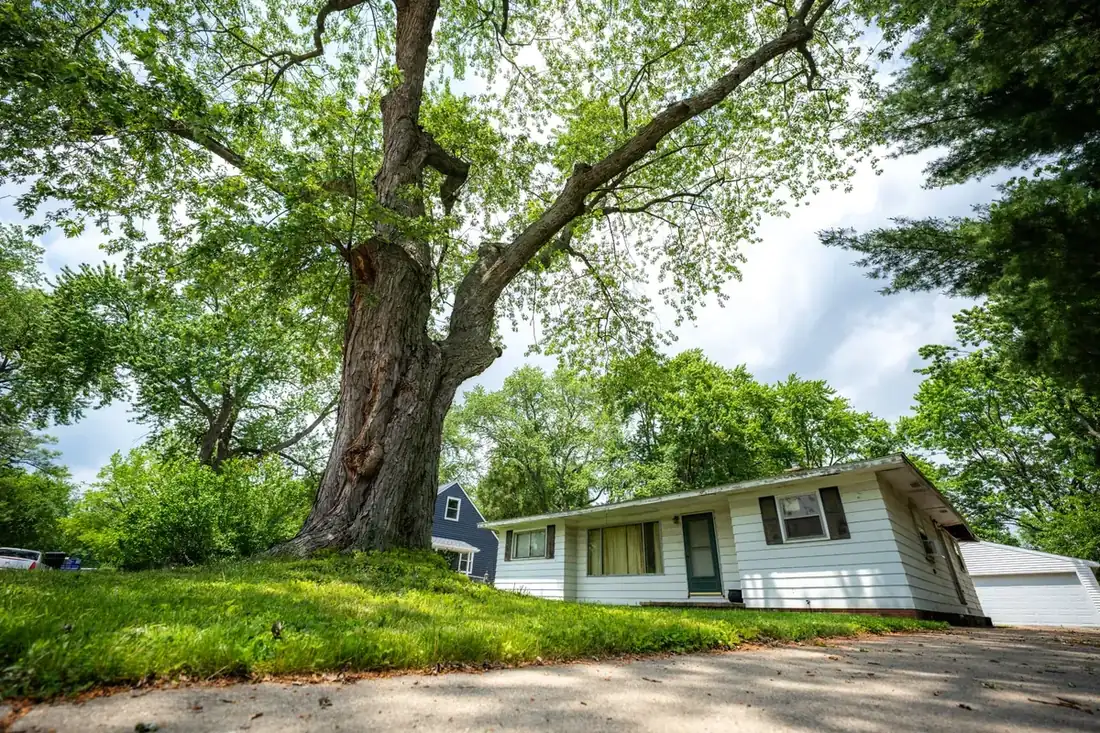
A walk-through takes twenty minutes. Look for ash with thinning crowns or bark falling away. Look for oaks that browned out suddenly this summer. Look up through your beech leaves. Note anything with a bare crown standing next to healthy neighbors — that is the picture at the top of this page, and it usually means something specific rather than old age.
Nate's Tree & Outdoor Services has worked across Southeast Michigan for over 20 years, and we will tell you honestly when a tree can be saved and when it cannot. Estimates are free, seven days a week. Call (734) 788-8822.
— Related Services —
— Keep Reading —