What to Expect on Tree Removal Day: A Homeowner's Guide
Most homeowners only go through a tree removal once or twice, so it is natural to wonder what the day will actually look like. How early does the crew show up? Where do the cars go? Will the lawn be wrecked? What happens to all that wood? Knowing the answers ahead of time makes the day go faster and more safely, and it helps you make a few decisions, like keeping the wood or grinding the stump, before the crew arrives rather than in the middle of the job. Here is what to do in the days before, what the crew is doing and why, and what to expect when the trucks pull away.
— Quick Points —
- Clear the area, move vehicles, and keep kids and pets inside. The drop zone for a felled tree can extend to twice the tree's height.
- If the stump is getting ground, MISS DIG 811 needs at least 3 business days' notice, and private lines like sprinklers and dog fences are not marked.
- Decide ahead of time whether you want to keep wood, chips, or neither, and whether the stump will be ground.
In the Days Before: Permits and Paperwork
Some Southeast Michigan communities require a permit to remove certain trees, especially larger trees, trees in the right-of-way between the sidewalk and street, or trees on regulated land. Rules vary a great deal from one city or township to the next, so check before the work is scheduled. We summarized the local rules in our tree removal permit guide.
If the tree is close to a property line, it is also a good time to talk with your neighbor. You will want their cooperation if the crew needs to set up on their side, lower wood over their fence, or park near their driveway, and nobody likes being surprised by a chipper at 8 a.m.
If a stump will be ground, MISS DIG 811 has to be notified at least 3 business days before the digging starts. It is free and required by law. MISS DIG marks public utility lines only. It will not mark private lines such as a line to a grill, shed, or detached garage, underground sprinklers, invisible dog fences, or pool equipment, so flag those yourself or tell the crew where they run.
Getting the Yard Ready
The best thing you can do is give the crew room. Move cars out of the driveway and away from the tree, ideally down the street, since the trucks and chipper will need the driveway and a falling limb does not care what it lands on. Move patio furniture, grills, planters, bird feeders, kids' toys, hoses, and anything decorative from under and around the tree.
Unlock gates and make sure the crew can get equipment through. If a fence section needs to come down for access, that should already be settled at the estimate. Tell the crew about anything they cannot see: septic tanks and drain fields, irrigation heads, buried downspout lines, and soft spots in the yard.
Keep kids and pets inside for the whole job. This is not a courtesy request. Tree crews set up work zones for a reason, and a dog running into the drop zone forces the work to stop at the worst possible moment.
The Job Briefing and the Drop Zone
When the crew arrives, the first thing that should happen is a job briefing. The crew leader walks the site, looks at the tree, the hazards, and the targets, and makes sure everyone knows the plan, their assignment, and how they will communicate. Industry safety standards for tree work call for this, and it is a good sign when you see it happen.
Next comes the drop zone, the area where wood will come down. Industry safety guidance summarized by ArborTIMES describes drop zones for felling as twice the tree's height, with smaller zones for pruning and piece-by-piece removal. Ground workers stay out of that area until the climber or operator calls it clear. You may hear a short call like 'stand clear' followed by an answer from the ground. That call-and-response is how the crew knows everyone is where they should be. Please stay outside the cones or tape, even if you just want to ask a quick question. Wave someone down instead.
Felling vs. Taking It Down in Pieces
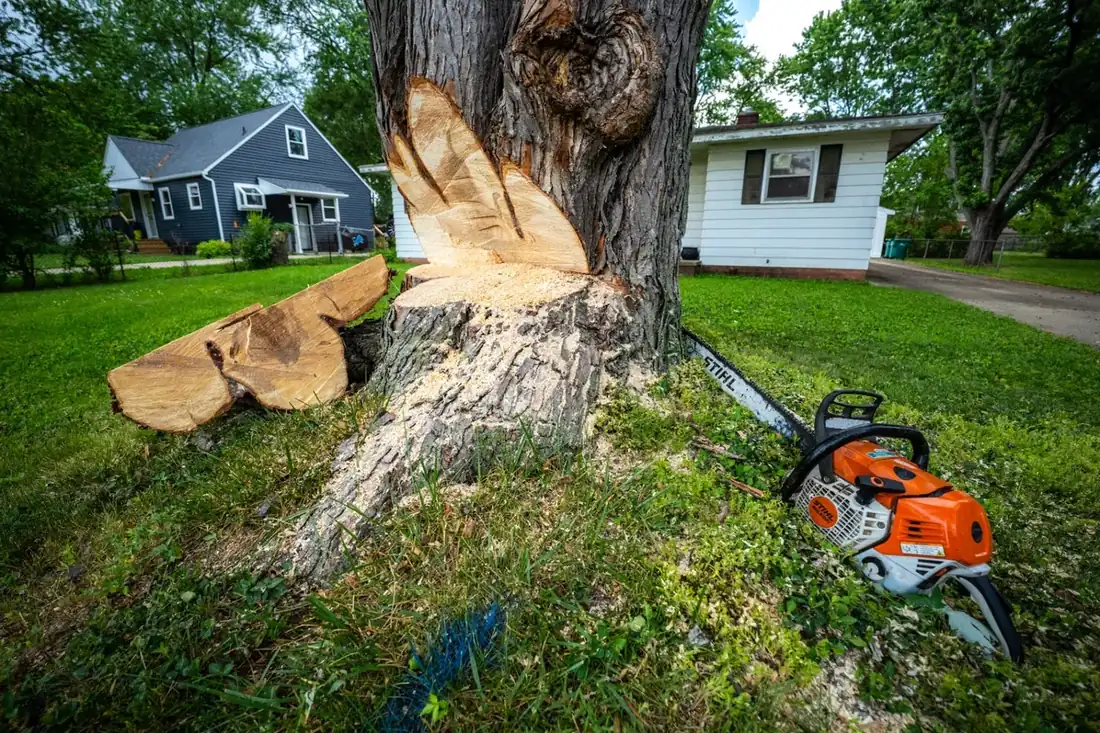
If there is open space at least as long as the tree is tall, and nothing in the way, a tree can sometimes be felled in one piece. The crew cuts a notch facing the direction of fall, then a back cut that leaves a hinge of wood to steer the tree down. This is the fastest method, but in most Southeast Michigan yards there is a house, garage, fence, or power line within reach, so it is less common than people expect.
Much more often, the tree comes down in sections. A climber or a bucket truck operator removes the limbs first, working from the bottom up or the outside in, and then takes the trunk down in manageable lengths. Pieces over something valuable are tied off and lowered on ropes through a friction device at the base of the tree, which lets the ground crew control the speed and set each piece down where it needs to go. Pieces over open lawn may be dropped. This is careful, repetitive work, and it is why a big removal near a house takes much longer than the same tree in an open field.
The Equipment You Will See
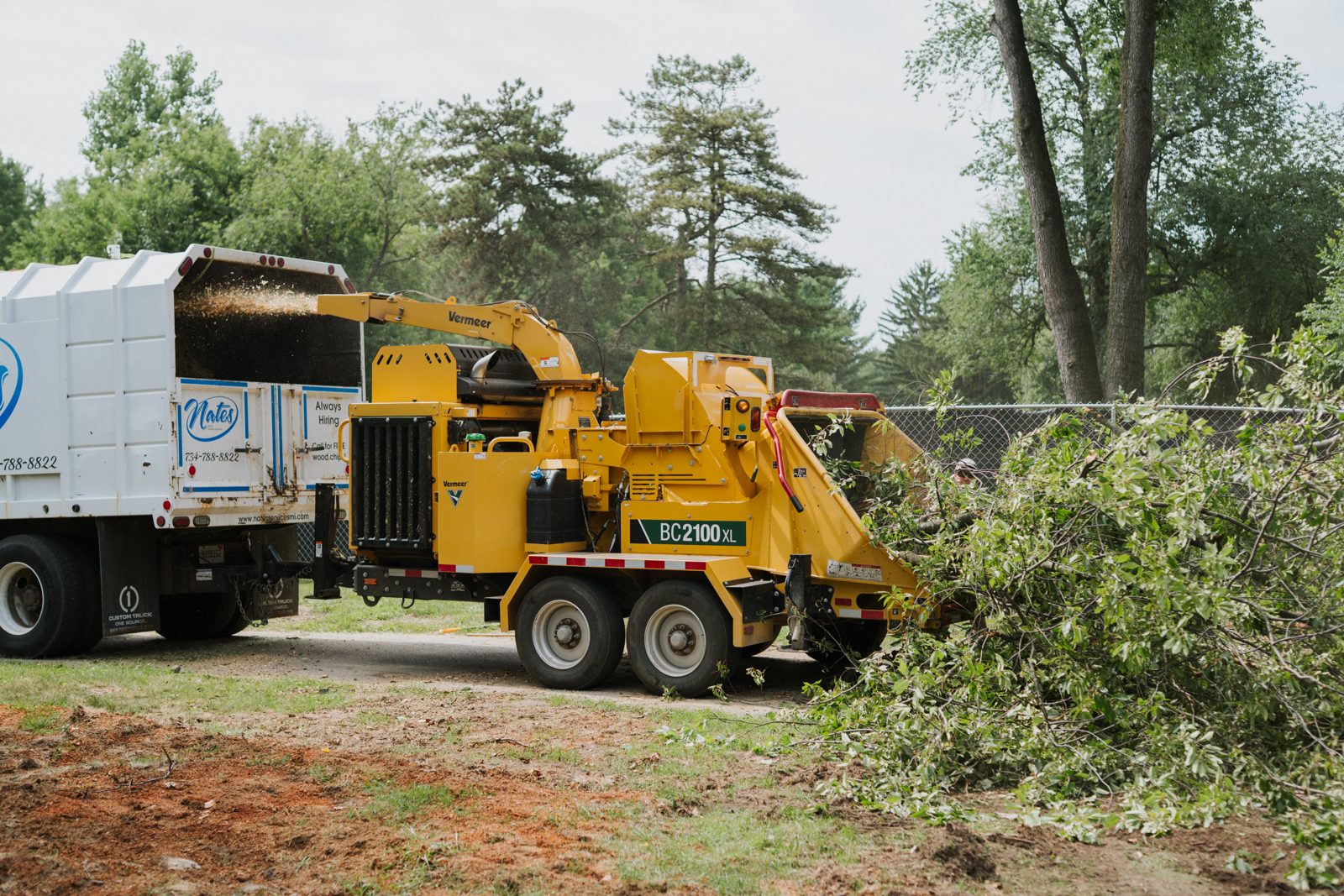
The chipper is the machine you will hear most. Brush is fed into it and blown into a chip truck or dump box. A bucket truck lifts a worker into the canopy where it can reach, which is faster than climbing when the truck can get close. Where it cannot, a climber works the tree on ropes and a harness.
Some crews use a compact loader, sometimes called a mini skid steer, to carry logs from the back yard to the street. It saves the lawn a great deal of foot traffic and log dragging, and it is what turns a two-day job into a one-day job. For very large trees in tight spots, a crane is sometimes used to lift sections over the house, which is a job-specific decision made at the estimate.
Noise and How Long It Takes
Tree removal is loud. Chainsaws and the chipper will run on and off all day, so if someone in the house works from home, takes calls, or has a sleeping baby, plan accordingly. Many cities have noise ordinances that limit the hours when this kind of work can happen, and crews generally work within normal daytime hours.
A small, accessible tree can be done in an hour or two. A large tree over a house, with lowering, cleanup, and log removal, can take a full day or more. Whoever writes your estimate should be able to tell you roughly how long your job should take. Weather can change the timeline too. High wind, lightning, and ice are all reasons to reschedule, and a crew that postpones for weather is making the right call.
Protecting the Lawn
Heavy equipment and heavy logs on soft ground leave ruts. When the ground is soft, crews commonly lay ground protection mats or plywood along the travel path to spread the weight, and they plan routes to avoid garden beds and irrigation.
This is one of the main reasons winter is such a good time for removals. Frozen ground carries equipment with far less damage, and dormant lawns and perennials are not in the way. We explained the other advantages in why winter is the best time to remove a tree in Michigan. In spring or after heavy rain, even with mats, some marking along the path is normal.
Cleanup and What Clean Should Mean
Ask at the estimate exactly what cleanup is included, because it varies. On a full-service job, clean generally means the brush is chipped and hauled, the wood is either removed or stacked where you asked, and the lawn, beds, driveway, and roof edges are raked and blown clear of twigs and sawdust.
Clean does not mean the yard looks like the tree was never there. Expect some fine sawdust in the grass, a few small twigs in beds, and flattened turf where logs and equipment moved. The sawdust breaks down, and the flattened grass usually recovers within a few weeks of growing season.
The Wood and the Stump
Make these two decisions before the crew arrives. For the wood, you can usually have it all hauled away, keep some rounds cut to firewood length, or keep a load of chips for mulch. Each option affects the price and the day's work. We laid out the pros and cons, along with the oak wilt and ash wood cautions, in what happens to the wood after a tree removal.
For the stump, a standard removal leaves it cut close to the ground. Grinding is a separate step that may happen the same day or on a later visit, depending on the schedule and the MISS DIG ticket. Stump grinding chews the stump down below grade and leaves a mix of soil and wood grindings in the hole.
Afterward: Ruts, Grindings and Replanting
Once the trucks leave, walk the yard. Light ruts can be raked out and topped with soil. Deeper ones are easier to fix in spring when the ground is workable. If the stump was ground, many homeowners rake out most of the grindings, fill with topsoil, and seed. Our post on stump grinding vs. leaving a stump covers regrowing grass over the spot in more detail.
If you plan to replant, do not put the new tree in the exact spot of the old stump, since the area will be full of decaying roots for years. Shift over a few feet, pick a species suited to the space, and give it room to grow. It is also worth asking why the old tree failed or had to come down, so you do not repeat the problem.
Ready to Schedule Your Removal?
We will walk the tree with you, explain how it will come down and what the yard will look like afterward, and settle the wood and stump questions before the day of the work. Free estimates across Livonia and all of Southeast Michigan. Call (734) 788-8822.
— Related Services —
— Keep Reading —