Tree Trimming Cost in Southeast Michigan: What Drives the Price
Tree trimming is one of the hardest home services to price from the curb. Two maples the same height can land hundreds of dollars apart because one hangs over a garage and the service line while the other stands alone in an open back yard. Published averages are a useful starting point, but they only tell you where most jobs fall, not where yours will. Below are the current ranges for the Detroit area, the factors that actually move a quote up or down, and the honest ways to get more tree work for the same money. We are not going to quote our own prices here, because every job is priced on the tree in front of us.
— Quick Points —
- Angi's Detroit data puts the average tree trimming job around $461, with typical jobs running roughly $271 to $1,805.
- Height sets the baseline, but access, how much wood comes off, and nearby wires or roofs often matter just as much.
- Bundling several trees, scheduling in the dormant season, and trimming on a regular cycle are the most reliable ways to spend less.
The Published Numbers for the Detroit Area
Angi's Detroit tree trimming page, updated in June 2026, reports an average cost of about $461, with a typical range of roughly $271 to $1,805. Broken out by height, it lists $100 to $400 for trees under 25 feet, $200 to $900 for trees 25 to 50 feet, and $400 to $2,100 for trees over 50 feet. Angi's national numbers are close to the local ones, with an average around $460.
Other cost guides run higher. HomeGuide puts a typical trimming job at $400 to $900 per tree, with a national average near $650 and minimum job fees of $100 to $300 or more. The gap between sources is mostly about what counts as a trimming job. A quick deadwood pass on a young tree and a full crown reduction on a mature oak are both called trimming, and they are not the same amount of work.
Treat these as a sanity check, not a price list. If a quote is far outside these ranges in either direction, ask what is included. If you want to compare against the cost of taking a tree down entirely, we covered that separately in our tree removal cost guide for metro Detroit.
Height Sets the Baseline
Height is the first thing any estimator looks at, because it decides how the work gets done. A 20-foot ornamental crabapple can often be pruned from the ground or a ladder in well under an hour. A 70-foot silver maple needs a climber in the canopy or a bucket truck, a ground crew to manage the limbs as they come down, and much more time on site.
Taller trees also mean longer limbs, heavier wood, and more of it to process. That is why Angi's over-50-foot range tops out several times higher than its under-25-foot range. Species matters here too: Angi's Detroit breakdown lists ornamental trees at $80 to $400, while maples, oaks, pines and ash all run into the $1,400 to $1,800 range at the top end, largely because those species grow big.
How Much Comes Off: Cleaning vs. Reduction
The second big driver is the scope of the work. Arborists describe pruning in specific terms under the ANSI A300 standard, and the type you choose changes the labor involved. A crown cleaning removes dead, dying, and broken branches. A crown raise lifts the lower limbs to clear a roof, driveway, or sidewalk. A crown reduction shortens the tree's overall height or spread by cutting back to properly sized lateral branches, which takes more cuts, more judgment, and more time.
A clearance job on one side of a tree, such as pulling limbs back off a roof, usually costs less than working the entire crown. If you are comparing two quotes and one is noticeably cheaper, check whether both companies are describing the same scope. We explain the terms in more detail in pruning vs. trimming: the key differences, and it is worth reading before you collect estimates so everyone is pricing the same job.
One way not to lower the price is topping. Cutting large limbs back to stubs looks like a lot of work removed for little money, but it leads to weak regrowth and decay and usually means more expensive work later.
Access, Bucket Trucks and Climbing
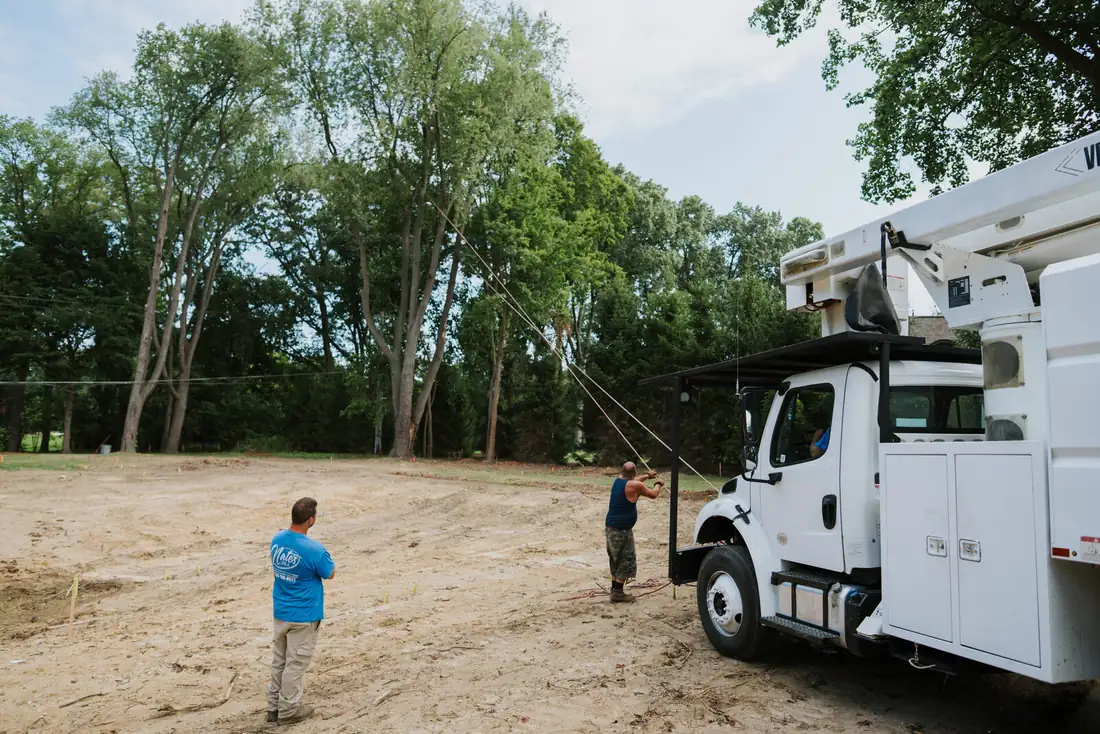
If a bucket truck can park beside the tree, the work usually goes faster and costs less. Many Southeast Michigan lots do not allow that. Back yards behind fences, narrow side yards, trees surrounded by gardens, soft lawns, septic fields, and slopes all push the job toward climbing and rope work. Angi's Detroit page specifically notes that access problems in older neighborhoods can raise the price because the work requires rigging or hand-climbing instead of a bucket truck.
Climbing is not worse work, just slower. A climber has to set lines, reposition, and often lower heavy limbs on ropes rather than let them drop. Every limb that has to be lowered instead of dropped adds time. When you get an estimate, it is fair to ask how the crew plans to reach the tree and whether equipment will need to cross your lawn.
Wires, Roofs and Other Targets
The more there is to hit under a tree, the more careful the work has to be, and careful work takes longer. Branches over a roof, a deck, a fence, a pool, or a neighbor's garage generally have to be roped down in controlled pieces.
Power lines are their own category. DTE Energy maintains vegetation around its pole-to-pole lines, but it states plainly that keeping branches away from your service drop, the line that runs from the pole to your house, is the homeowner's responsibility. Industry safety guidance summarized by the Tree Care Industry Association says tree workers without specialized electrical qualifications should not work within 10 feet of communication, secondary or primary lines. Depending on the situation, that can mean extra steps or coordination with the utility before trimming can happen, which shows up in the price. Angi's Detroit page also lists an electrician consultation at $75 to $130 per hour when branches are in contact with electrical lines.
Please do not trim near a line yourself to save money. Treat every wire as energized.
Species, Condition and Storm Damage
The condition of the tree changes the job. Dead wood is brittle and less predictable to climb and cut. Angi's Detroit page notes that emerald ash borer damage requires additional labor, and anyone who has worked in a dying ash knows why: the wood becomes unreliable, and the crew has to plan around that.
Storm damage is usually the most expensive trimming there is. Broken limbs hung up in a canopy, split leaders, and branches resting on a roof are under tension and have to be taken down with extra care. HomeGuide notes that emergency trimming after storms almost always costs more, and the timing works against you as well, since every tree company in the area is busy after a major storm. If a storm leaves a limb on your house, our 24-hour emergency storm work line is the right call, and cost is secondary to getting it safe.
Species also affects timing. The Michigan DNR asks that oaks not be pruned from April 15 to July 15 because of the oak wilt risk. If your oak needs work, plan it for the dormant season so you are not forced into a rushed or risky timeline.
Cleanup and the Number of Trees
Ask every company you talk to what happens to the branches. Most full-service quotes include chipping the brush and hauling it away along with raking the work area, but not all do. Angi lists yard cleanup in Detroit at roughly $50 to $85 per hour when it is priced separately, and HomeGuide lists debris removal at $75 to $250. If one quote leaves the brush in a pile at the curb and another hauls it, the cheaper number may not be cheaper.
The number of trees matters because much of the cost of any job is simply getting a crew and equipment to your driveway. Once everyone is there, the second and third trees cost less per tree than the first. Angi reports multi-tree discounts of around $100 per additional tree in the Detroit area. That is an average, not a promise, but the principle holds almost everywhere.
Honest Ways to Spend Less
Bundle your trees. If you have three trees that will need attention in the next year or two, get them done in one visit. It is the most dependable discount in this business.
Schedule in the dormant season. The Morton Arboretum recommends pruning most deciduous trees between late fall, after leaf drop, and very early spring. That is also the slower season for most tree companies, and HomeGuide notes that winter scheduling may bring lower rates. Frozen ground helps as well, since equipment can reach more trees without damaging the lawn. Our pruning calendar by species lists the exceptions.
Trim on a cycle instead of waiting for a crisis. A tree pruned lightly every few years rarely needs the expensive work: fewer large dead limbs, no branches grinding on the roof, and fewer emergency calls. Structural pruning while a tree is young is the cheapest tree work you will ever buy, because small cuts on a small tree set up a sound structure for decades. Neglect is what gets expensive.
Get the scope in writing. A clear estimate that lists which trees, which type of pruning, and what cleanup is included makes comparing quotes fair and protects you from surprises on the day of the work.
When You Do Not Need to Hire Anyone
Not every tree needs a crew. Small branches you can reach from the ground with a pole pruner or hand saw, water sprouts on a young ornamental, and minor shaping on shrubs are reasonable DIY jobs if you use good pruning cuts. Our post on common pruning mistakes covers the technique.
Call a professional for anything that requires a ladder and a chainsaw at the same time, anything near a wire, anything over a roof, and any limb too heavy to control by hand. Those are the jobs where people get hurt, and the price of trimming is modest next to the alternative.
Get a Real Number for Your Trees
Averages tell you the range. An on-site look tells you where your trees fall in it, what pruning they actually need, and what can safely wait another year. We will walk the property with you, explain what we see, and put the scope in writing. Free estimates across Livonia and all of Southeast Michigan. Call (734) 788-8822.
— Related Services —
— Keep Reading —