How Much Does Tree Removal Cost in Southeast Michigan? What Actually Drives the Price
Search for tree removal prices and you will find ranges so wide they are nearly useless. The numbers are real, but they average together a 20-foot ornamental in an open front yard and an 80-foot silver maple leaning over a garage. This guide gives you the published local ranges, then walks through how a removal is actually priced, so you can understand a quote, compare two of them fairly, and know which choices on your end change the number.
— Quick Points —
- Angi puts the Detroit-area average at about $752, with most jobs between roughly $200 and $2,000 (updated August 2026).
- Height sets the starting range. Access, rigging, condition, and power lines decide where in that range your job lands.
- Always confirm what is included: cleanup, wood haul-away, stump grinding, and permits are often separate.
The Published Numbers, and Why They Are So Wide
Angi's Detroit-area pricing, last updated in August 2026, lists an average of about $752 and a typical range of roughly $201 to $2,006. Broken down by height, trees up to 30 feet run about $150 to $500, trees 30 to 60 feet about $450 to $1,200, trees 60 to 80 feet about $800 to $2,000, and trees over 80 feet about $1,500 to $2,500.
Those are useful as a sanity check. They are not a quote. Two 50-foot trees can land at opposite ends of the same range, and the reasons are almost always the ones below.
How a Removal Actually Gets Priced
Every tree removal estimate is a prediction of time. The crew looks at the tree and estimates how many people, for how many hours, with which equipment, it will take to get every piece of that tree safely on the ground and off the property. Then it adds disposal.
That is why the questions an estimator asks are about the yard as much as the tree. Where can the truck park? Will a chipper reach? Can a mini-loader get through the gate? What is under the canopy? Each answer adds or removes hours.
Access: The Back Yard Premium
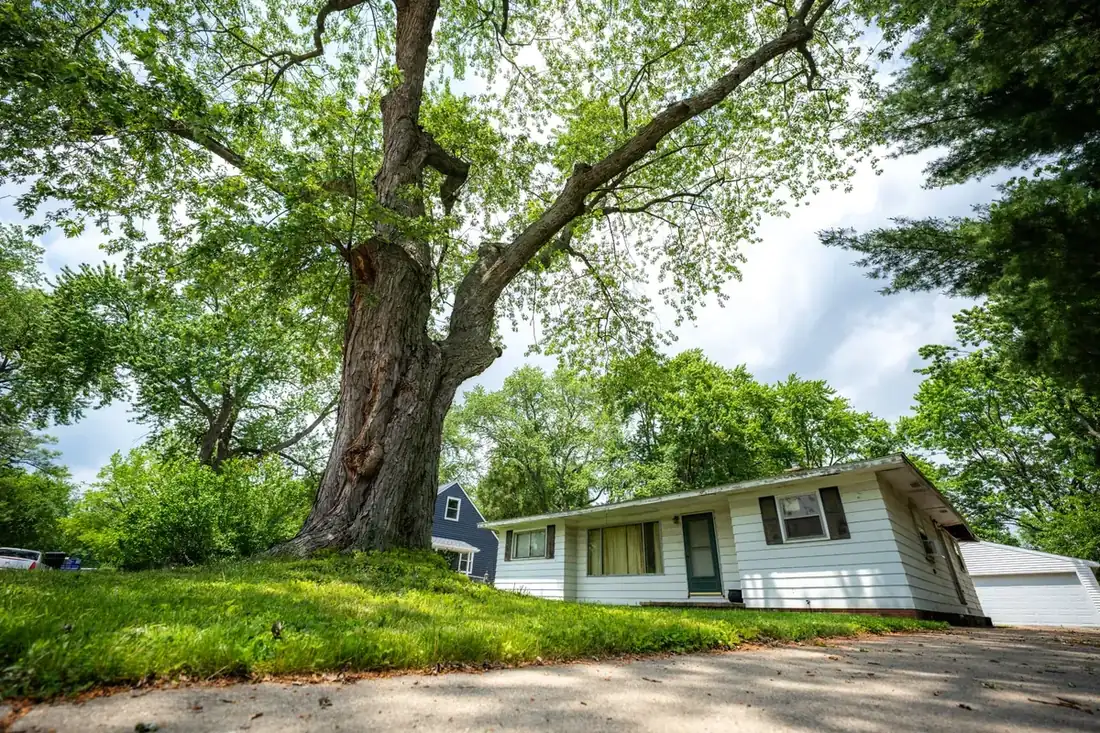
A tree in an open front yard next to the driveway is the cheapest kind of removal there is. The same tree in a fenced back yard, behind a garage, with a 36-inch gate, is a different job. If equipment cannot get to it, every log and every branch gets carried by hand to the street.
Angi notes that fenced yards and narrow access are common in the Detroit area and that hard-to-reach trees near structures or power lines can raise costs by 25 to 50 percent. Things that help: a wider gate that can be opened or a fence panel that can come out, clear space to park near the tree, and not having a new patio, pool, or septic field between the tree and the street.
Felling Versus Taking It Down in Pieces
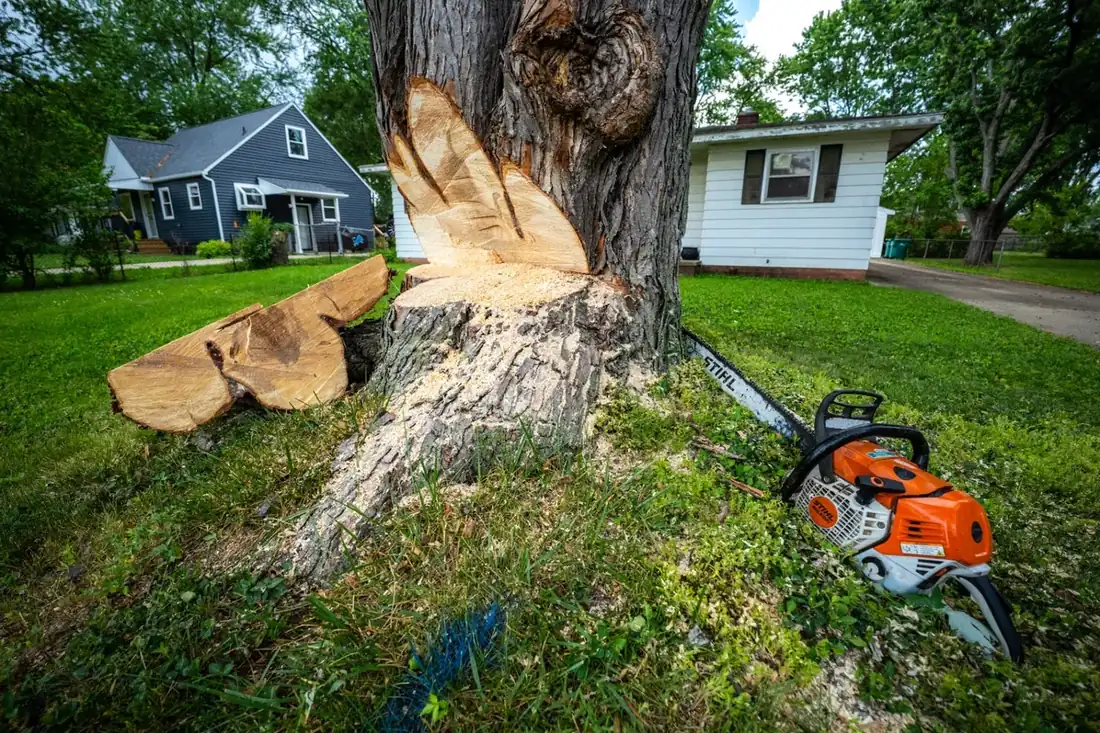
When there is enough open space, a tree can be felled in one piece: a notch, a back cut, and it lands where it was aimed. That is fast. When there is not enough room, the tree has to be dismantled from the top down, with a climber or a bucket truck cutting sections and lowering them on ropes so nothing hits the house, the fence, or the neighbor's roof.
Piece-by-piece removal, called rigging, is careful and slow, and it is the single biggest reason a tree near a building costs more than the same tree in the open.
Condition: Dead Trees Usually Cost More, Not Less
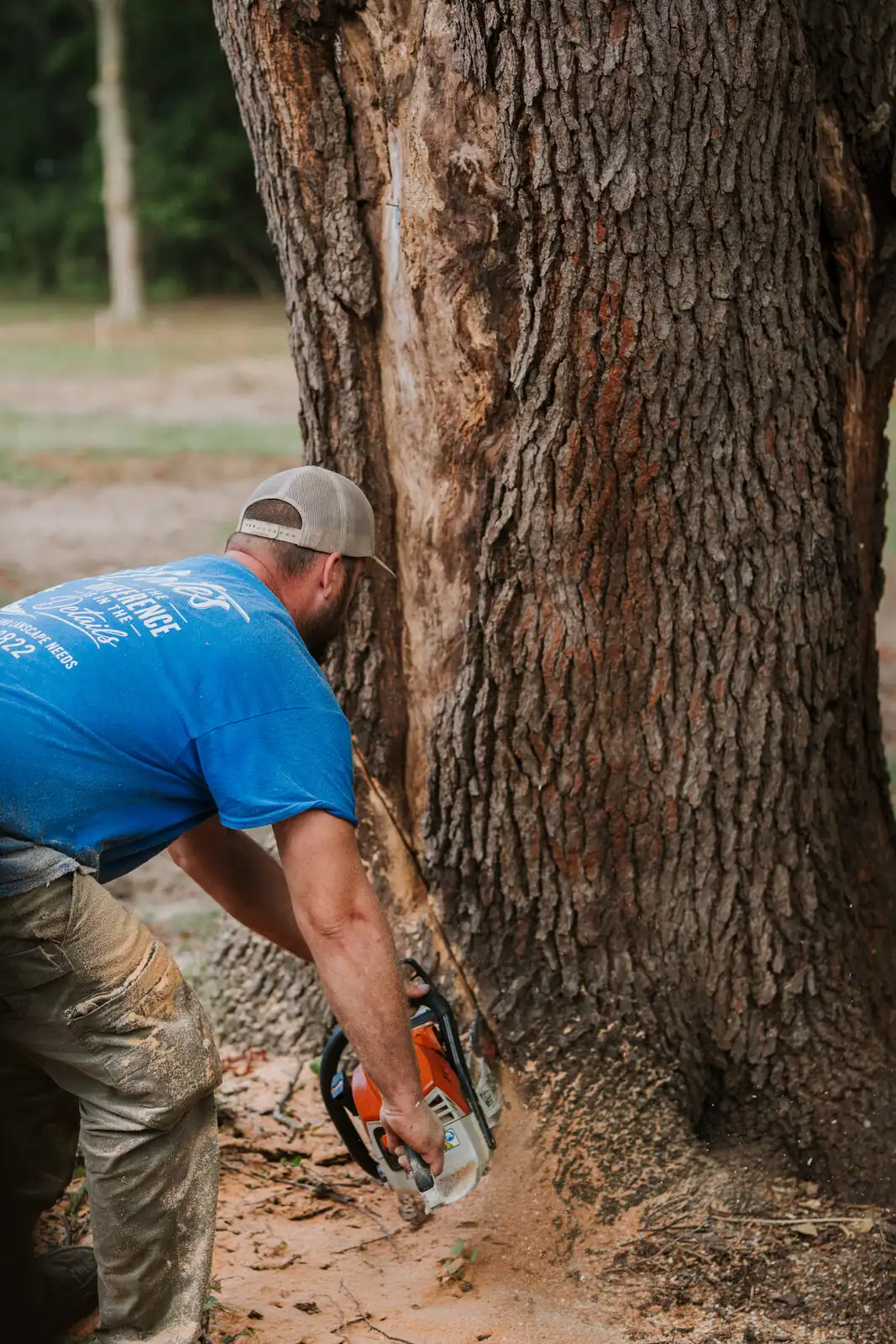
People are often surprised that a dead tree is not cheaper to remove. Dead wood is brittle and unpredictable. Branches can break off when a rope is tied to them, and a trunk that looks solid can be hollow. A healthy tree can usually be climbed; a tree that has been dead for a few years, especially an ash, often cannot be climbed safely and has to be worked from a bucket truck or lift.
The practical takeaway: if a tree is dying, removing it sooner is generally cheaper and safer than waiting until it is fully dead and brittle.
Power Lines Change the Job
A tree growing into overhead lines is a different category of work. Depending on which line it is, the job may require coordination with the utility before anyone can cut near it, and the crew must follow strict clearance rules. Who is responsible for which line is covered in our post on property lines, branches, and power lines in Michigan. For pricing purposes, expect more time and planning whenever wires are involved.
What Is Included, and What Is Not
Before you compare two estimates, make sure they describe the same job. The most common differences are cleanup and raking, hauling away the wood versus leaving logs or firewood-length rounds, chipping the brush, grinding the stump, and pulling any required city permit.
Angi lists debris services as separate line items in the Detroit area, around $70 for hauling, $95 for chipping, and $70 for splitting into firewood. Stump grinding is almost always priced separately. Permit requirements depend on your city and your tree; our city-by-city permit guide covers the rules in our service area.
If you keep the wood, keep it local. Michigan's guidance is not to move untreated firewood more than about 10 miles, because firewood is how tree pests travel.
Timing Can Move the Price
Frozen ground in January lets equipment roll across a yard without leaving ruts, which often means faster work and less lawn repair. Our post on winter tree removal explains why the slower season is the best time for planned removals.
The opposite end is storm work. A tree down on a house at night during a storm is an emergency job with urgent rigging, often in bad conditions, and it is priced accordingly. If you have a tree you have been worried about, having it assessed before storm season is almost always the cheaper path.
How to Compare Estimates Fairly
Get every estimate in writing, and check that it spells out: exactly which trees, whether the stump is ground and to what depth, what happens to the wood and brush, the cleanup standard, and who handles any permit or utility locate. Ask for proof of both general liability and workers' compensation insurance; Michigan's DNR recommends confirming both before hiring a tree service.
Be wary of anyone who knocks on the door right after a storm, asks for full payment up front, or cannot produce insurance paperwork. The lowest number is not a bargain if the job is not the same job.
Get a Written Estimate
Every tree and every yard is different, and the only way to know what yours will cost is to have someone look at it. We will walk the property with you, explain how we would take the tree down and why, and give you a written quote that spells out exactly what is included.
Free estimates across Livonia and all of Southeast Michigan. Call (734) 788-8822.
— Related Services —
— Keep Reading —