Tree Struck by Lightning: Will It Survive and What to Do Next
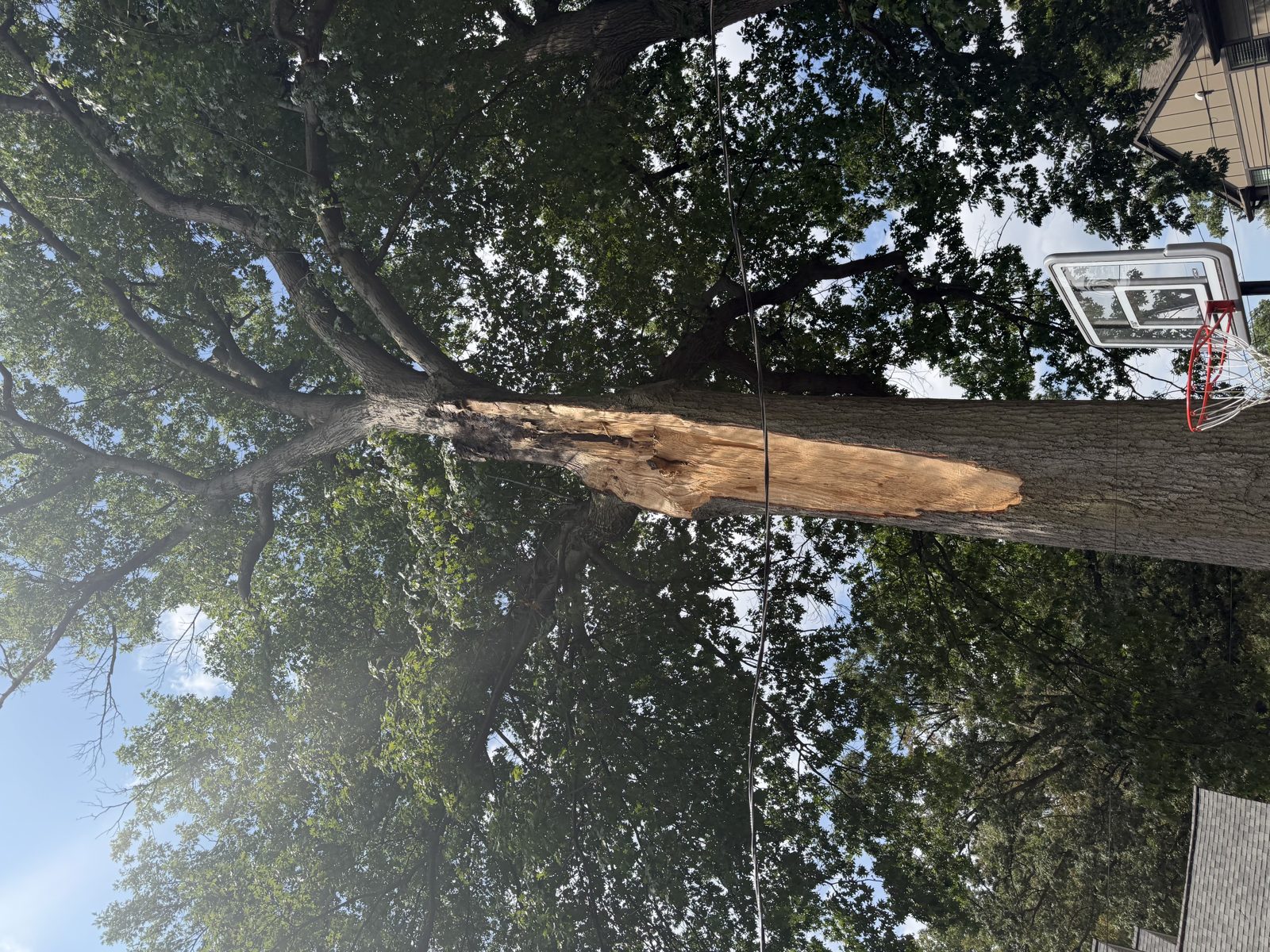
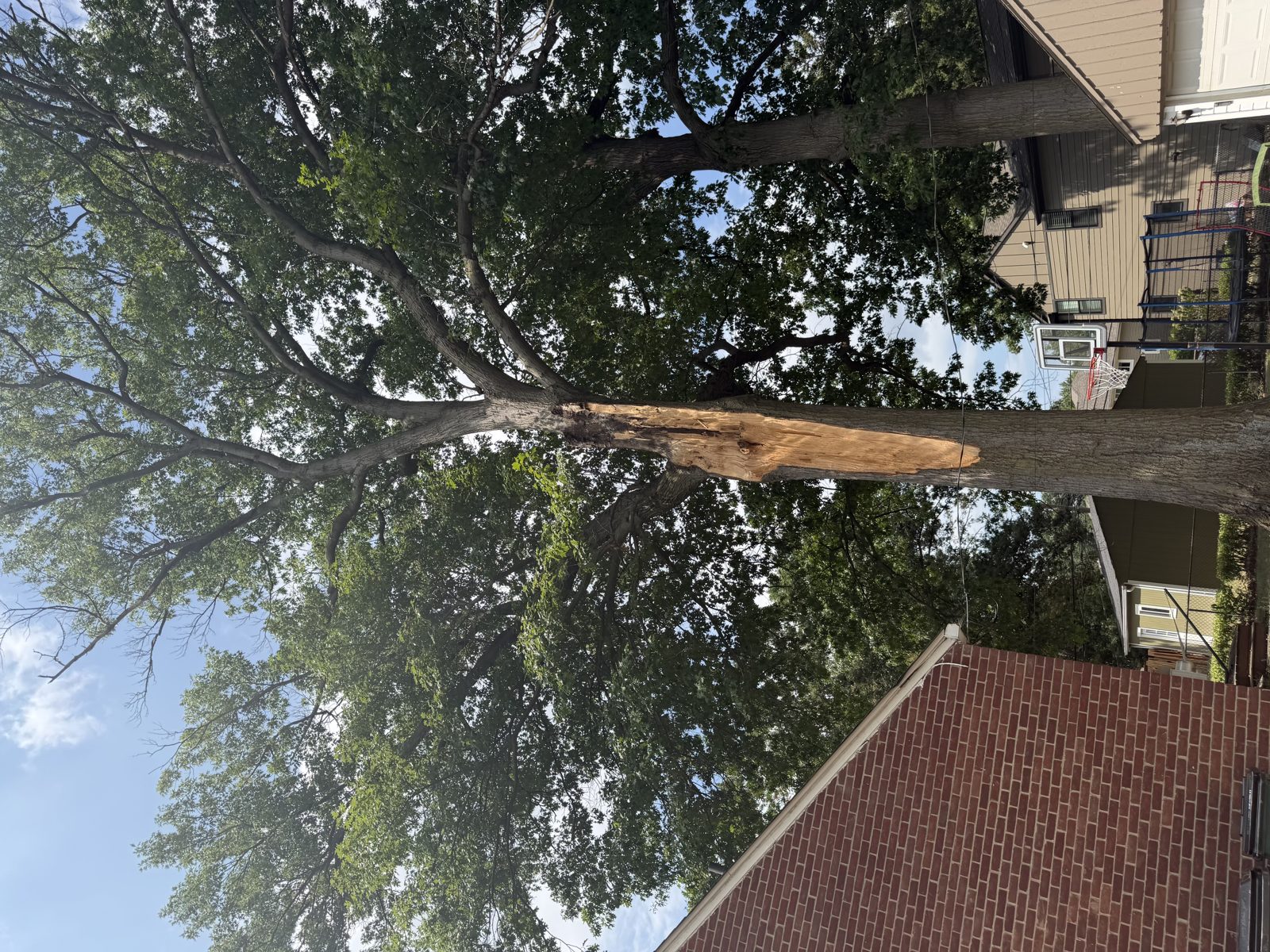
A lightning strike on a yard tree is loud, sudden, and usually followed by a strip of bark lying on the lawn. Some trees look destroyed and live for decades. Others look barely touched and die the next summer. Extension foresters in Alabama and Nebraska say the same thing: you often cannot tell right away. What you can do is keep people safe, look for the damage that means the tree has to come down now, protect the tree from what comes next, and give it time. Here is what happens inside a struck tree, which ones get hit, and how the next few weeks and seasons should go.
— Quick Points —
- Split trunks, deep cracks into the wood, or loss of more than a third of the bark or canopy are the signs Alabama Extension says point to removal.
- If the damage is less severe, water in dry spells, clean up loose bark carefully, and wait: survival often is not clear for weeks or even a full season.
- Stay clear of a struck tree until the storm has passed, check it for smoke or smoldering, and look up for cracked limbs before you walk under it.
What Lightning Does to a Tree
Alabama Extension's guide on caring for lightning-struck trees describes a bolt carrying up to 100 million volts at temperatures around 50,000 degrees Fahrenheit. When that current runs through the moist wood and sap just under the bark, it boils the water instantly. The steam is what does the visible damage. It blows bark off and can crack or split the wood.
The results range widely. Nebraska Extension lists everything from a narrow strip of bark blown off the trunk to a completely debarked tree, deep vertical cracks in branches or the trunk, and invisible interior damage. The classic sign is a stripe of missing bark running down the trunk, sometimes straight and sometimes spiraling with the grain. Clemson's Home and Garden Information Center notes that pines tend to show spiral damage while oaks and elms often show a one-sided wound.
Some trees get it worse. The trunk can shatter, the top can be blown out, or bark and wood chunks can be thrown across the yard. And some trees show almost nothing on the outside because the current traveled through the inner wood or down into the roots.
Which Trees Get Hit
Lightning tends to find the tallest thing around. Nebraska Extension notes that solitary trees in open space, trees on hilltops and the tallest tree in an area are the most prone to strikes. Clemson adds trees near water.
Species matters too. Clemson's Home and Garden Information Center lists ash, elm, oak, maple, poplar, pine and spruce as trees that are struck frequently, and beech, birch and horsechestnut among those struck less often. The explanation usually given is bark texture. Smooth-barked trees get soaked during a storm and the water carries the current down the outside, while rough bark stays drier and forces more of the current through the wood.
In Southeast Michigan that list covers a lot of the big trees in older neighborhoods: mature oaks, silver maples, cottonwoods and spruces that stand taller than the houses around them.
Safety First, Before You Look at the Tree
Do not go out to inspect the tree while the storm is still going. The CDC's lightning guidance is to wait at least 30 minutes after the last thunder before going back outside, and it notes that the beginning and end of a storm are the most dangerous times. Standing next to a tall tree is exactly where you do not want to be.
Once it is safe, look up before you walk under anything. A strike can crack limbs that have not fallen yet, and a loose slab of bark can let go days later. Keep kids and pets away until someone has looked at the canopy.
Check for smoke. Lightning can ignite dry or decayed wood inside a trunk, and that fire can smolder out of sight. It is rare in a Michigan yard, but if you see smoke, smell burning, or see glowing wood in a cavity, call 911 and let the fire department deal with it. Also look for downed wires. If a limb brought down a line, stay away and call DTE.
When the Tree Needs to Come Down Now
Some damage does not call for waiting. Alabama Extension recommends removing the tree if the trunk is totally or partially split apart, or if deep cracks extend into the woody tissue. Nebraska Extension uses the same thresholds and adds damage that runs deeper than a third of the trunk's diameter.
Alabama Extension also points to removal when more than a third of the canopy has been blasted out along with major scars, or when more than a third of the bark has been removed around the trunk's circumference, because decay is very likely to follow. Both extension services say location weighs heavily: a damaged tree near the house, garage, driveway or a busy street is a stronger candidate for removal than one out in a field.
A split trunk over a roof is exactly the situation our emergency storm work crew handles. If the tree has already come down on the house, our guide on what to do when a tree falls on your house walks through the first hour.
The First Few Days
If the tree is standing with a bark strip and no split, the first job is cleanup and protection. Nebraska Extension recommends removing loose bark and broken branches. Alabama Extension suggests tracing the wound only if needed, meaning trimming the ragged, loose bark edges back to firmly attached bark without cutting into healthy tissue or making the wound larger. Broken limbs hanging in the canopy should come out, which is usually a job for a crew with climbing gear, not a ladder.
In our area there is one extra step for oaks. The Michigan DNR's oak wilt high-risk period runs April 15 through July 15, and the DNR advises that an oak wounded during that window be painted right away with latex paint or wound dressing to keep sap beetles off the fresh wound. A lightning scar on an oak in June counts. Outside that window, and on most other species, wound paint is generally not needed.
Alabama Extension also discusses bark beetles and ambrosia beetles attacking stressed trees after a strike, especially pines. That is worth knowing if you have a struck spruce or pine. Talk to an arborist or MSU Extension before applying anything.
The Next Few Weeks
This is the waiting period, and it is the hard part. Alabama Extension says to wait several weeks for the damage to become evident before making a removal decision on a tree that is not obviously split. Internal damage can cut off water movement, and a tree that looked fine the day after the storm may suddenly wilt.
What helps is water. Alabama Extension recommends deep watering so the top 6 to 9 inches of soil are moist, limited to once or twice a week. Nebraska Extension's advice is to water when conditions are dry so drought stress does not stack on top of the injury. In a hot July on clay soil, that can make a real difference.
What does not help is guessing. Watch for wilting, leaves browning on one side, bark that loosens beyond the original strip, or new cracks. Take photos of the wound from the same spot once a week so you can compare.
Next Season: The Real Verdict
Nebraska Extension is blunt about it: a struck tree, even one with little apparent damage, may not survive, and only time will tell. For many trees the answer comes the following spring. Leaf-out that is full and even is a good sign. Leaf-out that is thin, late, or missing on one side, or new dieback in the top, means the roots or conducting tissue were damaged more than the outside showed.
Also watch the wound. A tree that is recovering starts rolling new callus wood in from the edges of the strip. A wound that stays dry and gray with bark peeling back further, or starts showing fungal growth, is a tree that is losing the fight. Signs of decay and cracks covered in our post on signs a tree is going to fall apply here too.
Will Insurance Cover It?
Maybe, and it depends heavily on your policy. Lightning is commonly listed as a covered peril on homeowners policies, and GEICO's consumer guidance notes that coverage usually hinges on what the tree damaged. If a struck tree or limb hits the house, garage or another covered structure, that damage and some of the removal may be covered. A tree that is struck but does not hit anything often is not.
Even when removal is covered, GEICO notes many policies cap debris removal, commonly around $500 per tree and $1,000 per incident. Check your policy, take photos of the strike damage before anything is cleaned up, and call your agent before assuming either way.
Can You Prevent It?
For a tall, valuable tree standing alone near the house, lightning protection systems exist. Clemson describes copper conductors run from the top of the tree down to ground rods, and Alabama Extension recommends them only for high-value or historically significant trees, installed by specialists. They are not common on residential lots, and most homeowners never need one.
The more practical prevention is keeping trees healthy and structurally sound so that if one is struck, it has the best chance of walling off the damage and recovering.
Tree Hit by Lightning? We Can Take a Look
If a strike split the trunk or left limbs hanging over the house, call and we will get the dangerous parts down safely. If the damage is less clear, we will tell you honestly whether it looks like a tree to wait on or one to remove, and when it does need to come out, our tree removal crew handles it.
Free estimates across Livonia and all of Southeast Michigan. Call (734) 788-8822.
— Related Services —
— Keep Reading —