A Tree Just Fell on Your House. Here's What to Do in the First Hour.
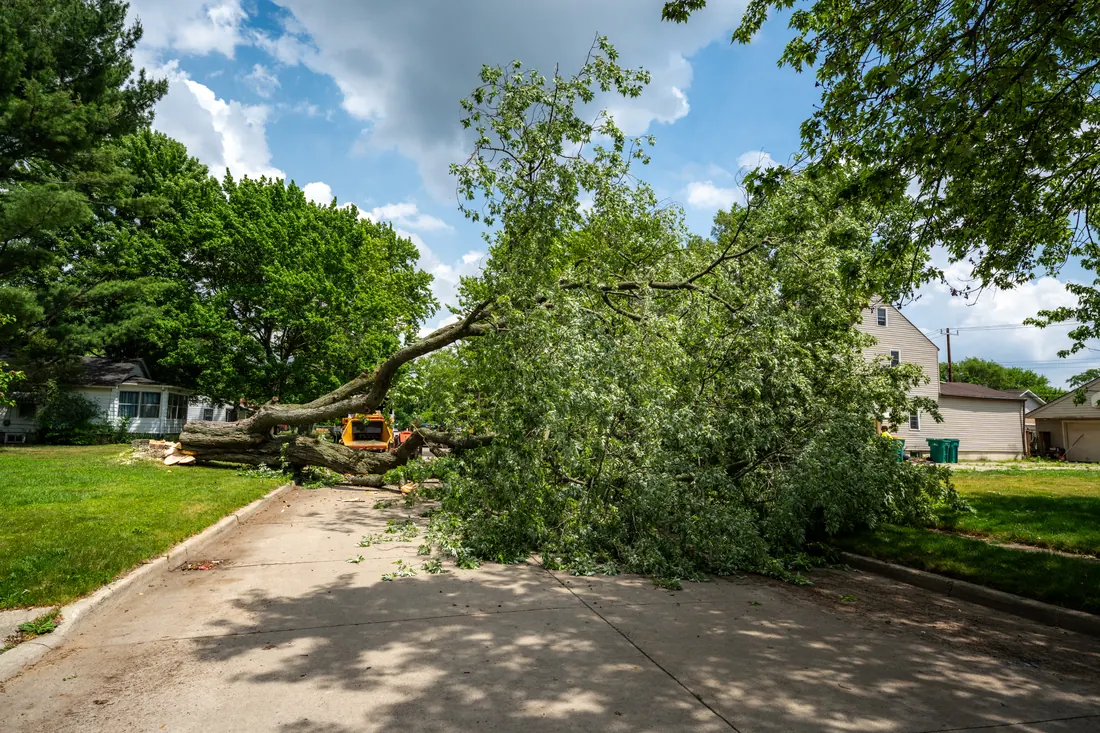
Southeast Michigan gets hit. The National Weather Service office in Detroit has logged an average of about 6.6 tornadoes a year across southeast Lower Michigan since 1950, most of them between April and August. In February 2023 an ice storm coated the region in a quarter to a half inch of glaze, and DTE reported close to 3,000 downed wires and roughly half a million customers without power. In June 2024 an EF-1 tornado cut a five-and-a-half-mile path through Livonia. When a tree comes down on a house here, it is not a freak event. What you do in the next hour affects your safety, your insurance claim, and how much of this you end up paying for yourself.
— Quick Points —
- Treat every downed wire as live. DTE says stay at least 25 feet back from the line and anything touching it.
- Photograph everything before anyone moves a branch — your claim depends on it.
- Your policy probably pays far less toward tree removal than you expect.
Wires First, Everything Else Second
Before you look at the roof, look for wires. A tree that takes down a limb often takes down a line with it, and an energized conductor lying in wet grass does not spark, hum, or move. DTE's published guidance is to assume every downed power line is dangerous and to stay at least 25 feet away from it and from anything it is touching — debris, the tree itself, a fence, a parked car, a ladder.
Call 911 first, then DTE's 24-hour emergency line at 800-477-4747. If the line is burning, report it to both. Do not try to drag branches off a wire, and do not let anyone walk the yard until you know where the conductors are. This is the part of the job that kills people, and it is the part homeowners most often underestimate because the wire looks inert.
Keep everyone out of the affected rooms of the house too. A tree resting on a roof is holding load. It can shift when the wind picks up again or when the wood dries and settles.
What Not to Touch
There is a strong instinct to start cutting. Resist it for four specific situations.
Anything in contact with a wire. Anything under tension — a limb that is bent, pinned, or holding another limb's weight will move violently when it is cut, and there is no way to predict which direction from the ground. Anything that requires a ladder or climbing. And anything resting against the structure, where taking the wrong piece first drops more weight onto the roof instead of less.
Also, do not haul the debris away before your insurance adjuster has documented it. Once it is gone, so is the evidence of what actually happened.
Photograph It Before You Do Anything Else
Your phone is the most valuable claim tool you own in the first hour. Photograph and video the tree, the point of impact, the damage inside the house, the yard, and the wider scene showing where the tree stood. Get the base of the trunk and the root plate if it uprooted. Do it before anything is moved.
Then call your insurer. The Insurance Information Institute's guidance on storm claims is straightforward: contact the company immediately, confirm your coverage and deductible, take reasonable steps to prevent further damage — tarp the roof, board the openings — and keep every receipt, because those emergency costs count toward the settlement. What you should not do is start extensive permanent repairs before the adjuster has seen it.
Keep a log. Dates, names, what each person told you. If the claim stalls unreasonably, Michigan's Department of Insurance and Financial Services takes consumer complaints at 877-999-6442.
The Insurance Reality Nobody Tells You
This is where most homeowners are surprised, so it is worth being blunt.
If the tree struck your house, garage, shed, or fence, the damage to that structure is generally covered under your policy, minus your deductible. But the tree removal itself is capped, and the cap is low. The standard homeowners policy form pays up to $1,000 for removing fallen trees from the premises per loss, and no more than $500 of that for any one tree. That $1,000 is the ceiling regardless of how many trees came down.
If the tree fell in the yard and hit nothing, there is typically no removal coverage at all. The usual exception is if it is blocking your driveway or an accessibility ramp.
If the tree is damaged but still standing — split trunk, hanging limb over the porch — that is generally not covered either. The debris-removal clause applies to trees that have already fallen. A leaning, cracked tree that is obviously going to fail is your cost, not the insurer's.
And preventive removal of a dead tree is never covered. Insurance pays for sudden accidental loss, not maintenance.
Every carrier writes its own version, so read your declarations page rather than taking these numbers as gospel. But go in expecting the removal bill to be largely yours.
Whose Line Is It, Yours or DTE's?
There is a split that decides who pays, and almost nobody knows it until they need to.
The wires running pole to pole down the street belong to DTE. If a tree is on those, DTE handles it — report it at 800-477-4747 or through their power line problem form.
The service drop is the wire coming off the pole to your own house, and that one is yours. DTE says outright that it does not maintain vegetation there, and it will only step in when a tree on a service drop has already caused an outage or a hazard.
And a tree that came down from natural causes is the customer's to remove. DTE clears what interferes with its equipment. Everything else — the tree on your roof, the trunk across the driveway, the stump — is between you, your insurer, and your tree service.
Be Careful Who Knocks on the Door
Michigan's Attorney General issues a post-storm scam warning nearly every storm season, which tells you how reliable the pattern is. Crews follow the weather, work the neighborhood door to door, ask for large deposits, and are gone before the work is finished.
The Michigan DNR's own guidance for hiring tree services is short and worth following: confirm the company carries both general liability and workers' compensation insurance, and get quotes from two or three arborists. Workers' comp matters more than people realize — if an uninsured cutter is hurt in your yard, that can become your problem.
Beyond that: get everything in writing before you sign, never pay for an entire job up front, pay by credit card rather than cash, and walk away from anyone who needs a decision right now. Under Michigan's Home Solicitation Sales Act you generally have until midnight of the third business day to cancel a contract signed at your door — though that right can be waived for genuine emergency work with a separate handwritten statement, which is exactly the clause storm chasers use.
When to Call Us
We run 24-hour storm response across Southeast Michigan, and the calls that go best are the ones where the homeowner did three things: got everyone away from the wires, photographed the scene, and did not start cutting.
If a tree is on your house right now, call (734) 788-8822. We are licensed and insured, we will tell you honestly what is urgent tonight and what can wait until morning, and estimates are always free.
— Related Services —
— Keep Reading —