Signs a Tree Is Going to Fall: Warning Signs in a Living Tree
Most trees that come down in a storm were not dead. They had leaves, they looked fine from the kitchen window, and they had a defect nobody was looking for: a crack in a fork, a hollow at the base, a root plate that had started to lift. A dead tree is easy to spot. A living tree with a structural problem takes a closer look. Here are the warning signs university extension services point to, how to think about what the tree could hit, and what the realistic options are once you find something.
— Quick Points —
- Cracks, included bark in tight V-shaped forks, and decay are the defects most likely to turn a healthy-looking tree into a failed one.
- Soil heaving or cracking on the side opposite a new lean means the roots are moving, and that tree needs a professional look soon.
- A defect only becomes a hazard when there is something in the fall zone. The same crack means very different things over a garage versus a back field.
Why a Living Tree Fails
Purdue University's forestry extension puts it simply: trees fail at their weakest point, and failure is usually a defect combined with an outside force. The force in Southeast Michigan is predictable. Summer thunderstorms bring straight-line wind, spring rain saturates clay soil, and winter brings ice. The defect is the part you can do something about ahead of time.
That is why this is a different check from deciding whether a tree is alive. If you are wondering whether a tree has died, start with our guide on how to tell if a tree is dead. Everything below applies to trees that are still green and growing, which is exactly why these problems get missed.
Cracks and Splits
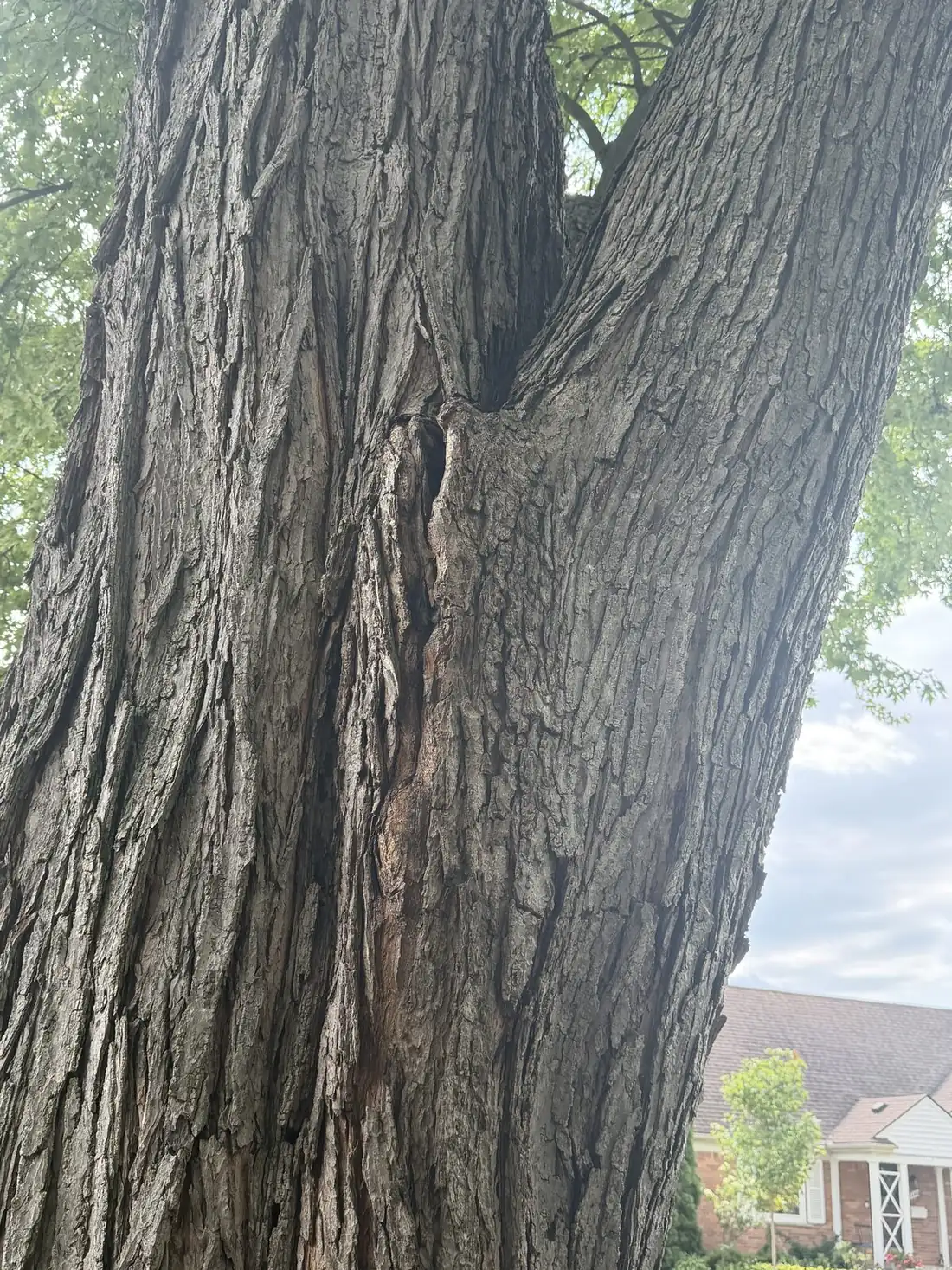
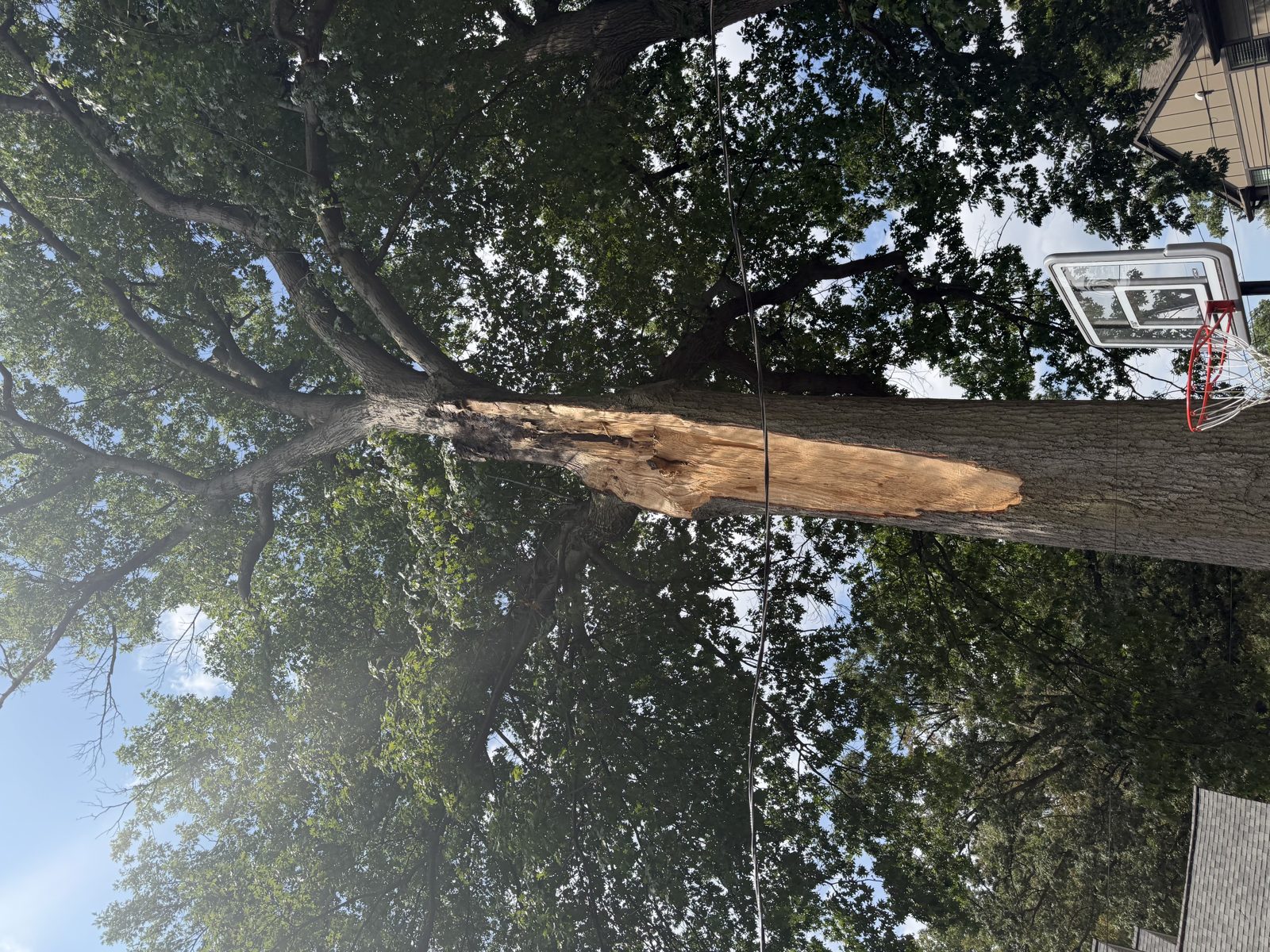
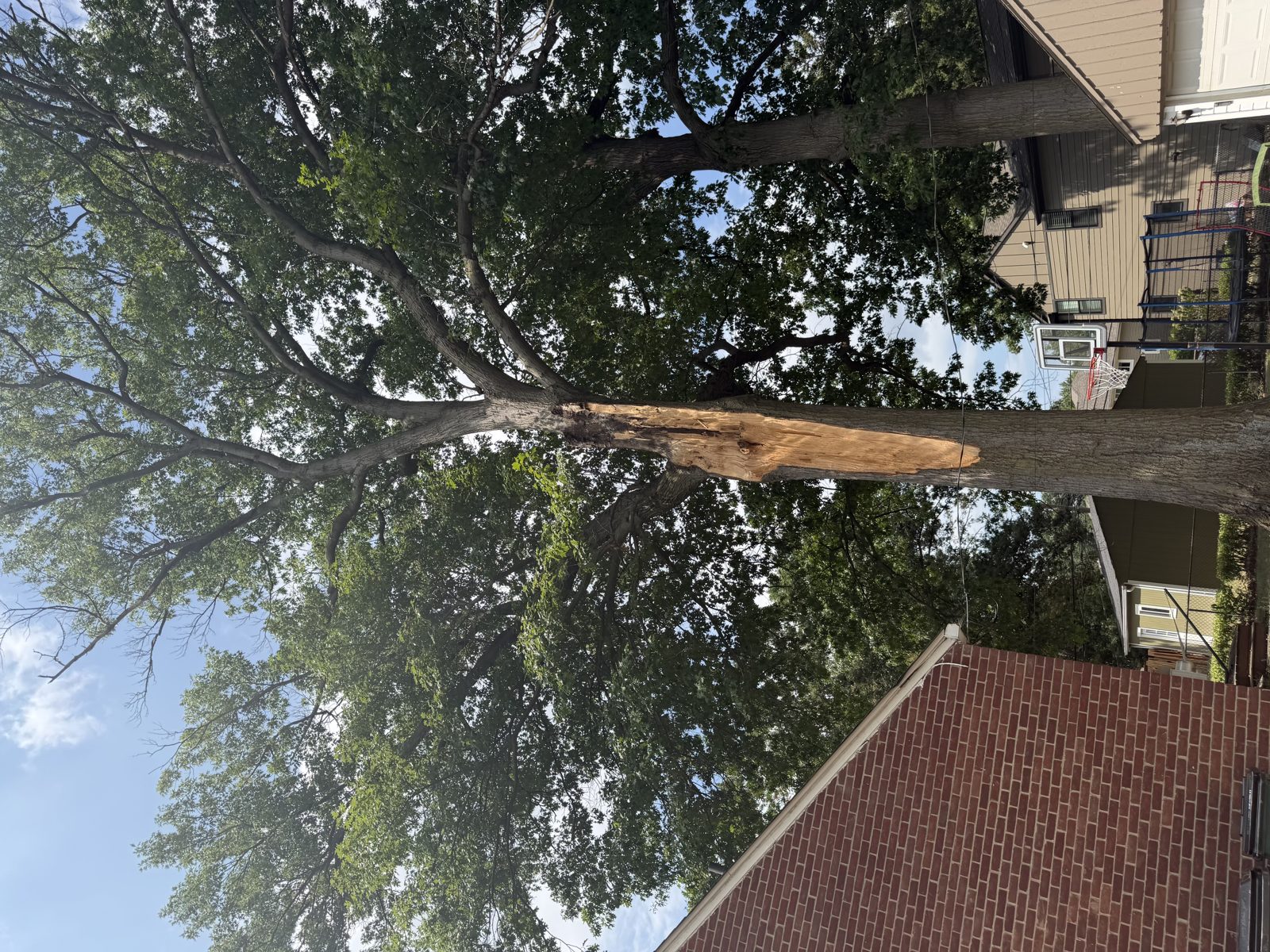
The University of Nebraska-Lincoln's Tree Hazard Awareness guide calls cracks perhaps the most critical tree defect. A crack means the wood has already separated. It is no longer a question of whether the tree is weak at that point but how much load it has left.
Alabama Extension draws a useful distinction. Vertical cracks running along the trunk let decay fungi in and deserve attention. Cracks running across the trunk or a limb, perpendicular to the grain, are particularly dangerous because they cut through the wood's strength. Illinois Extension adds that multiple cracks in the same area, or a split that goes deep into the wood rather than just the bark, calls for immediate action.
Look at the trunk, the base of major limbs, and especially the point where two stems meet. A crack you can slide a finger into, or one that opens and closes as the tree moves in wind, is not something to watch for another season.
Tight V-Forks, Included Bark and Codominant Stems
A codominant stem is two trunks or leaders of about the same size growing from the same point. Nebraska Extension notes that multiple leaders create weak attachments and raise the chance of limb failure. The problem gets worse when the fork is a tight V instead of a wide U.
In a tight V, bark gets pinched between the two stems as they grow. That is included bark, and Illinois Extension describes it as acting like a wedge that pushes the stems apart. Instead of wood knitting the two stems together, there is a seam of bark. Callery pear, maples, ash and elm are the species Illinois Extension names as particularly prone to it, and silver maple, which is all over the older neighborhoods of Wayne and Oakland counties, is a textbook example.
Signs a codominant fork is getting worse: a crack running down from the bottom of the V, a seam of bark that looks like it is bulging outward, or one stem that has started leaning away from the other. When a fork like that fails, half of a large tree comes down at once.
Cavities, Decay and Fungus
Decay is what turns a small structural weakness into a failure. The Morton Arboretum explains that trees wall off wounds by producing compounds that isolate the decayed area, and decay stays contained as long as that barrier holds. That is why plenty of trees live for decades with a hollow. It is also why a hollow is never a sign to ignore, because the question is how much sound wood is left around it.
The outside signs are fungal conks or shelf fungus on the trunk, mushrooms at the base, carpenter ants, soft or crumbly wood, and seeping sap. Tree risk guidance also points to odd bulges or asymmetric swelling on the trunk as a possible sign of internal trouble, because the tree adds wood to compensate for a weak spot.
One thing not to do: fill the cavity. The Morton Arboretum notes that older practices of filling cavities with concrete often backfired, and that the tree's own new wood is stronger than anything put in the hole. Scraping out decayed wood can also break through the barrier the tree built.
Root Plate Heaving and a New Lean
A tree that has leaned the same way for thirty years has usually adjusted to it with extra wood on the right side. A lean that is new, or one that has gotten worse, is a different story. Nebraska Extension flags a progressive increase in lean as a sign that failure risk has jumped.
Check the ground on the side opposite the lean. Alabama Extension describes heaving or mounding soil at the base, on the side away from the lean, as the root plate pulling out of the ground. On our clay soils that is most likely after days of spring rain, because Alabama Extension explains that saturated soil loses the friction that holds roots in place.
If you see a fresh lean with lifted soil or torn roots on the back side, stay out from under the tree and call. That is the one sign on this list that can go from bad to on-the-ground in a single windy afternoon, and it is the kind of situation our 24-hour emergency storm work exists for.
Root Damage From Construction
Some of the trees that fail were fine until a project happened near them. A new driveway, a sewer lateral replacement, an addition, a trench for an irrigation line, or even trucks parked on the root zone for a few weeks. The Morton Arboretum notes that roots spread at least as far as the branches and often much farther, and that construction damage may take two to three years to show up as dieback.
So the tree that lost roots in a 2024 driveway replacement may start thinning at the top in 2026, and the owner rarely connects the two. Purdue Extension notes that if more than 30 percent of a tree's roots are exposed after storm damage, removal may be the better option. Roots cut on one side of a big tree also remove anchorage on that side.
If you are planning work near a tree you want to keep, the time to think about roots is before the excavator shows up. Our post on landscaping around trees covers the critical root zone in more detail.
Dead Hangers and Lopsided Canopies
Even on a healthy tree, a broken limb that is hung up in the canopy is one of the most dangerous things in a yard. Illinois Extension points out that dead wood does not bend like live wood and snaps in high winds. A hanger that has already broken can drop with no wind at all.
Canopy shape matters too. Alabama Extension notes that trees with uneven crowns struggle to distribute stress from wind and snow, and Purdue describes crown twist, where a one-sided canopy puts torsion on the trunk and causes splitting.
One common cause of a lopsided or suddenly exposed tree is a neighbor taking out trees next to it. Purdue Extension notes that trees newly exposed to prevailing winds through development or removal can be at greater risk. A tree that grew up sheltered in a group has not built the trunk and roots to stand alone. If the trees around yours came down in the last year or two, give the survivors a closer look, and if the tree straddles a lot line, our post on whose tree it is under Michigan property-line rules covers the neighbor side of things.
Targets and the Fall Zone
Here is the part homeowners tend to skip. Alabama Extension states that without a potential target, a tree cannot qualify as a hazard. The Morton Arboretum defines tree risk as the chance a tree fails combined with the impact of that failure. A cracked cottonwood at the back of a five-acre lot is a different problem from the same tree over a bedroom.
To size up the fall zone, estimate the tree's height and picture it lying flat in every direction the defect could send it. Then add some margin, because trunks slide, limbs bounce, and tops break off and travel. Anything inside that circle is a target: the house, the garage, the driveway where cars park, a play set, the patio, a neighbor's roof, the street, and the service drop from the pole. Trees falling on power lines can cause outages, surges and fires.
Also think about how often people are there. A limb over the back of a detached garage nobody uses is lower risk than the same limb over the kids' swing. A defect with a high-use target under it moves to the front of the line.
Michigan Weather Is the Test
Our storms give defects a hard exam. Research compiled by Connecticut's forestry program found ice can increase branch weight by a factor of 10 to 100, and it lists included bark, dead branches, broad crowns and fine branching as the features that make a tree fail under ice. Silver maple, willow, Bradford pear, American elm and Siberian elm are among the species it lists as most susceptible.
Summer brings the other half: saturated ground followed by strong wind is when root plates let go. A tree with a known defect over a target is not something to leave until after the next storm season. Fall and winter, when the leaves are down and the structure is visible, is the easiest time to see all of the above.
What the Options Actually Are
Finding a defect does not automatically mean the tree comes down. The main options are pruning out defective branches, installing support systems, improving routine care, and removal when the risk cannot be brought to an acceptable level.
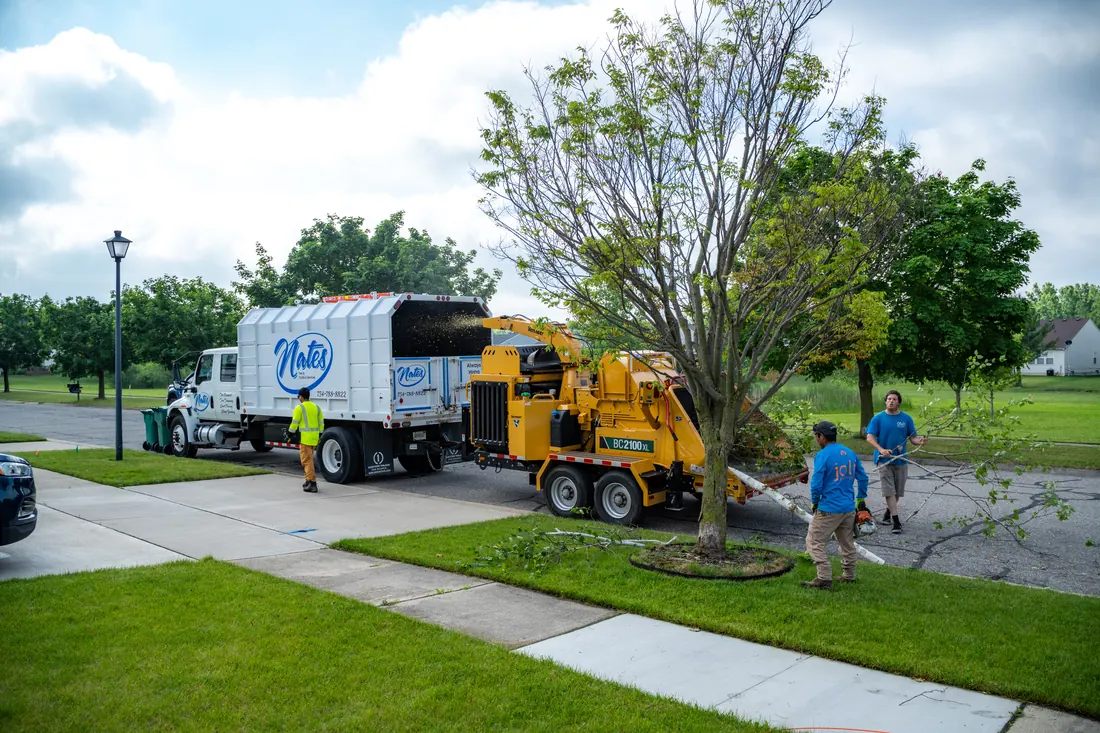
Pruning can remove a dead hanger, a cracked limb, or reduce the weight on the end of a long, heavy branch. Reduction pruning shortens a leader or limb to cut the leverage wind has on a weak fork. Our tree trimming crew handles hazard limb removal and structural pruning.
Cabling and bracing is the other tool arborists use. Purdue Extension describes it as limiting how far a branch or leader can move and transferring load from a weak union to a stronger one. It is used on otherwise healthy trees with a weak fork or an overextended limb, not on trees with significant decay. Purdue is also clear that support systems are no guarantee against failure and need inspection: a ground check every year and a climbing inspection by an arborist every three years. If you are considering it, talk to an arborist who installs support systems.
Removal makes sense when the defect is severe, the tree is in decline, or the target is too important to gamble with: an active split through the trunk, a root plate that is lifting, decay through most of the base, or a failing codominant fork over the house. Honestly, some trees with defects are fine to leave alone. A hollow tree in the middle of a woodlot with nothing around it can be good wildlife habitat for years.
Worried About a Tree Near Your House?
If you found a crack, a V-fork with a seam, fresh soil movement or a hanger over something that matters, have someone look at it before the next storm does. We will walk the tree with you, tell you what we see, and if the right answer is pruning or leaving it alone, that is what we will say. If it needs to come down, our tree removal crew can take it out in sections without dropping it on anything.
Free estimates across Livonia and all of Southeast Michigan. Call (734) 788-8822.
— Related Services —
— Keep Reading —