Mushrooms at the Base of a Tree: What They Mean and What to Do
Late summer and fall is mushroom season in Michigan, and a lot of homeowners notice something new at the foot of a tree: a cluster of tan mushrooms, a bright orange shelf, a hard brown bracket on the root flare. Some of these mean nothing at all. Others are the only outside sign of rot eating the roots and lower trunk, which is the kind of decay that lets a tree look healthy right up until the day it tips over. The difference comes down to what the fungus is and exactly where it is growing. Here is how to tell the harmless ones from the ones that deserve a closer look, and what to do next.
— Quick Points —
- Mushrooms scattered in wood chip mulch or lawn a few feet from the trunk are usually just breaking down organic matter and do not harm the tree.
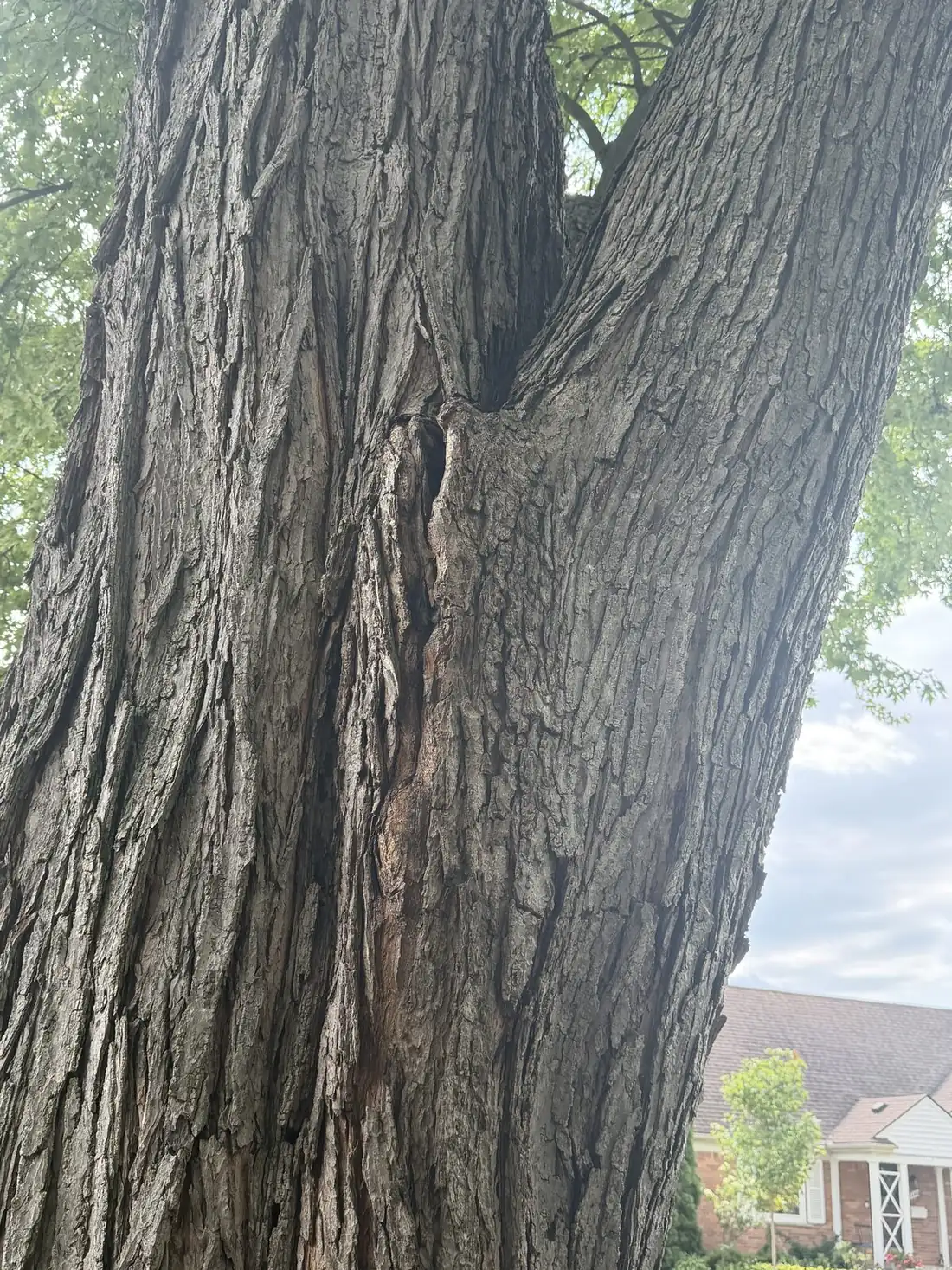
- Mushrooms or conks growing from the trunk, the root flare or the roots often mean root or butt rot, which weakens the tree where it needs the most strength.
- There is no cure for wood decay. The job is to find out how much sound wood is left, and remove the tree if it is not enough and there is something to hit.
A Mushroom Is the Fruit, Not the Fungus
The mushroom or shelf you see is only the reproductive part of the fungus, the part that makes spores. The fungus itself lives out of sight as a network of threads inside wood or soil, sometimes for years before it fruits. That is why the mushroom matters as a clue. It tells you a fungus is feeding on something right there.
When that something is the tree, the news is usually not early. University of California IPM notes that a fruiting body on a tree is usually associated with advanced decay, and that the decay can extend well above or below the spot where the conk appears. Pulling the mushroom off does nothing to the fungus inside.
Mushrooms in Mulch and Lawn: Usually Harmless
Start with the good news. UMass Extension says the mushrooms, slime molds, bird's nest fungi and stinkhorns that pop up in wood chip and bark mulch are a natural part of mulch breaking down and are not harmful to landscape plants. They are feeding on the mulch, not the tree. Raking the mulch to let it dry out knocks them back, and replacing mulch every few years helps.
The one mulch fungus with a real downside is artillery fungus, which shoots tiny sticky spore masses up to about 12 feet onto siding and cars, where they look like specks of tar and are hard to remove. UMass suggests using bark nuggets rather than shredded wood near the house. Mushrooms in the lawn often come from buried wood, such as roots left from an old tree, and they fade as that wood is used up.
One important caveat. Some root rot fungi fruit from the soil a few feet out from the trunk, right over an infected root. UMass notes this for both hen of the woods and one type of chicken of the woods. So a cluster in the grass near a big tree is worth identifying before you dismiss it. Whatever it is, keep kids and pets from eating it. Plenty of lawn mushrooms are poisonous.
Why Root and Butt Rot Is a Stability Problem
Iowa State Extension defines the terms: butt rot is decay in the wood at the base of the tree, and root rot is decay in the roots. The same fungus often causes both. They get in through wounds from mowers, trimmers, vehicles and construction equipment, and through roots cut by trenching or digging. Iowa State also notes these fungi can move between trees through grafted roots.
The problem is where the decay sits. The base of the trunk and the root plate carry every bit of load from the crown above, and that is exactly the wood these fungi eat. UC IPM notes that losing just 10 percent of a wood's weight to decay can mean a 70 to 90 percent loss in strength. UMass Extension points out that a tree with Armillaria can look healthy for years and then fail suddenly in the wind. That is the scenario we worry about: a full green canopy on top of roots that are no longer holding.
Honey Mushroom (Armillaria)
Honey mushrooms are among the most common fungi at the base of trees in the Great Lakes region. UMass Extension describes dense clusters of golden tan to brown caps, from late August through October, with a noticeable ring on the stem. They grow right at the base of the tree or from roots nearby.
The mushrooms come and go, but Armillaria leaves other evidence. Peel back loose bark at the base of a declining tree and you may find flat, white, fan-shaped sheets of fungus. Dig at the soil around the flare and you may find black, shoestring-like strands called rhizomorphs. University of Minnesota Extension says those strands can grow up to 10 feet through the soil to reach new roots, that the decayed wood turns white, soft and stringy, and that the rot can reach several feet up into the trunk. Above ground, you may see thinning, yellowing leaves or browning needles and dead branches in the top.
Armillaria goes after trees that are already stressed by drought, defoliation or root damage. There is no cure. Minnesota Extension recommends having an arborist check the tree's stability and, when it is removed, taking out the infected stump and roots before replanting.
Ganoderma: The Shiny or Crusty Shelf at the Flare
Ganoderma forms hard, shelf-shaped conks on the lower trunk and exposed roots. The Missouri Botanical Garden describes two common types. One looks lacquered, a shiny reddish-brown with a white edge, and is sometimes called varnish fungus. The other, often called artist's conk, is a dull brown with a white edge that weathers to gray. Conks can reach about 14 inches across, and a fine brown dust of spores often coats the bark around them.
This one is serious. Maples, oaks and honeylocust are among the most common hosts, all trees that are everywhere in Southeast Michigan yards and streets. The Missouri Botanical Garden says that by the time the conks are noticed, it is too late to reverse the infection, that trees can decline within a few years of infection, and that they are prone to being blown over. Their advice is to remove infected trees promptly, especially large ones near people or property.
Chicken of the Woods (Laetiporus)
Chicken of the woods is hard to miss: bright orange to yellow shelves stacked on top of each other, from about July through October. UMass Extension describes two types. One forms overlapping shelves on the trunk and root flare. The other grows in orange rosettes near the soil line or from roots several feet from the trunk. Oaks are the most common host, but maples and beech get it too. Some people forage it. We are not going to weigh in on eating anything that grows on a tree. Our interest is in what it says about the wood.
What it says is not good. Laetiporus causes a brown rot in the heartwood, which UMass says leads to dramatic reductions in the wood's bending strength and can progress a long way before it shows. Their guidance is a thorough risk assessment whenever it appears, because infected trees can uproot or snap under wind load.
Hen of the Woods (Grifola) on Oaks
Hen of the woods grows as a big, ruffled rosette of overlapping grayish-brown caps at the base of oaks, usually from late summer into fall. UMass Extension says oaks are its primary host and that it causes a white pocket rot in the roots and lower trunk that advances slowly.
This is the one where the honest answer is often wait and watch. UMass notes that oaks with hen of the woods are not necessarily at high risk of failure, and that some show no detectable internal decay when tested with sonic tomography. They recommend monitoring and a risk assessment rather than automatic removal. If the tree does need pruning or work, remember the oak rule: the Michigan DNR's high-risk window for oak wilt runs April 15 through July 15, so oak work belongs outside it.
Other Shelf Fungi on the Trunk
Conks higher up on the trunk or on big limbs tell the same basic story at a different spot. UC IPM explains that some fungi rot the heartwood at the center, which can go on for years without visible symptoms, while others attack the living sapwood and cause dieback you can see in the canopy. A conk on a dead branch is mostly about that branch. A conk on the main trunk is about the trunk.
Fungus is one of several signs we look at when judging a tree, along with bark, buds and canopy, which we walk through in how to tell if a tree is dead. The decay fungi above are the ones that deserve more than a glance.
What to Do When You Find One
Take a clear photo of the mushroom or conk, note exactly where it is growing (trunk, root flare, a root, or open soil) and how far it is from the trunk, and look at what the tree could hit if it went over: the house, the garage, the driveway, a play set, the street, a power line. That combination of what the fungus is and what is underneath the tree is what drives the decision.
Then look for company. Mushrooms at the base plus a new lean, cracked or heaving soil on one side, dead branches in the top or cracks in the trunk is a much more urgent picture. We cover those warning signs in signs a tree is going to fall. A professional assessment can go beyond looking: sounding the trunk with a mallet, and, as UMass Extension describes, tools like resistance drilling or sonic tomography that estimate how much sound wood is left.
In the meantime, reduce stress. Iowa State Extension recommends mulching around the base, deep watering in drought, avoiding soil compaction and protecting trees during construction. UC IPM notes that wound dressings do not prevent decay, so skip the spray paint. The best prevention is keeping mowers and string trimmers away from the trunk and roots.
When to Call, and What Removal Involves
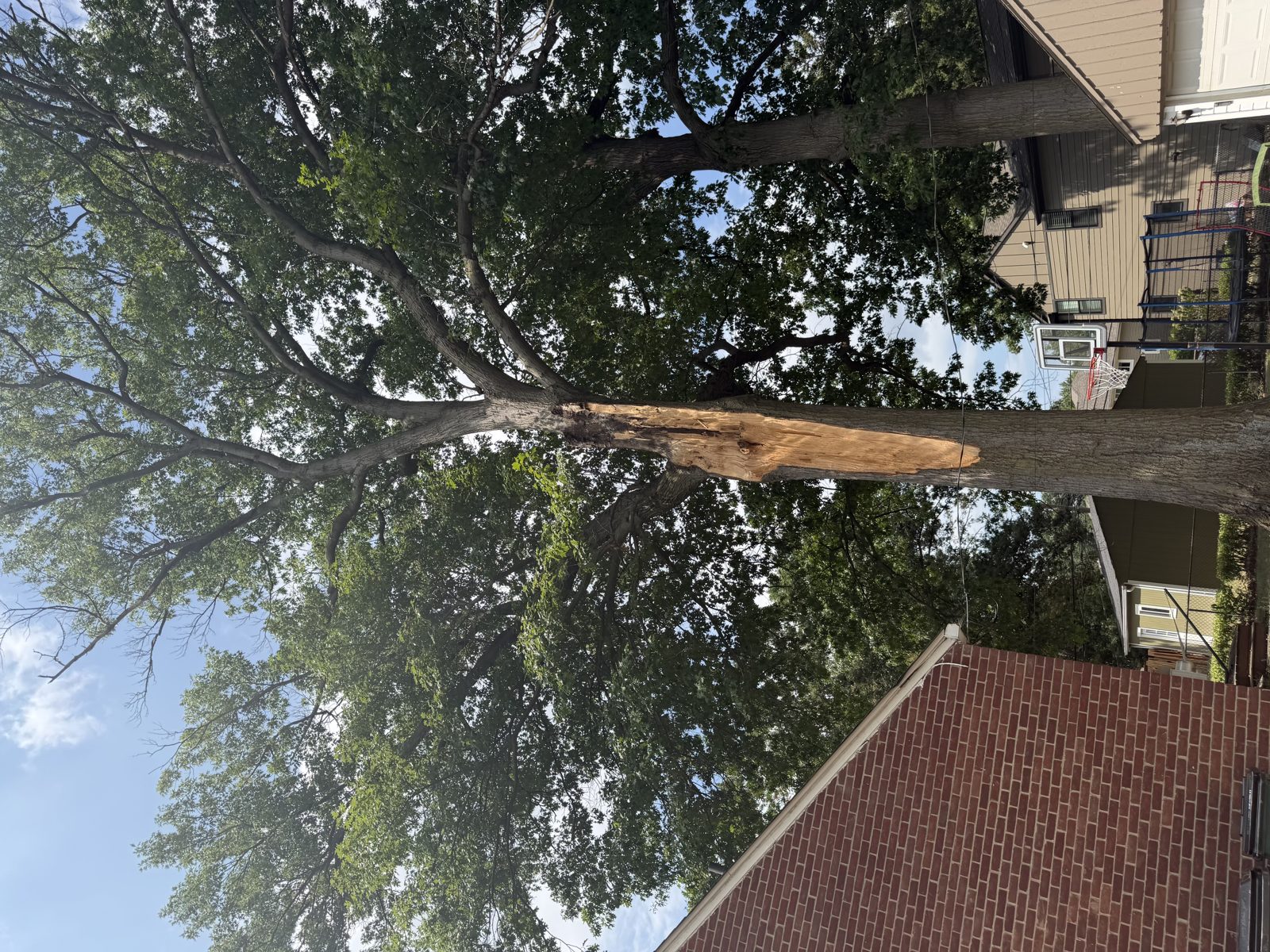
Call soon if Ganoderma, Armillaria or chicken of the woods is growing from the base of a large tree that can reach something you care about, or if any base fungus shows up alongside a lean or lifting soil. If a storm has already lifted the root plate or dropped the tree, our 24-hour emergency storm crew handles that. Not every mushroom means removal. Hen of the woods on a vigorous oak, or mushrooms in the mulch, may mean nothing more than keeping an eye on it.
When a decayed tree does need to come down, it is often a more careful removal than it looks, because the base may not hold the way a sound tree would. For Armillaria in particular, Minnesota Extension recommends getting the infected stump and roots out before replanting. Grinding takes out the stump but not every root, so read our stump grinding guide and plan to put the new tree in a different spot.
Found Fungus at the Base of Your Tree?
Send us a photo or have us take a look in person. We will tell you whether it is something to watch, something to act on, or nothing to worry about. Free estimates across Livonia and all of Southeast Michigan. Call (734) 788-8822.
— Related Services —
— Keep Reading —