Why Winter Is the Best Time to Remove a Tree in Michigan (and Why to Book It Now)
Most people call about a tree in the summer, when it is leafed out and shading the deck, or right after a storm drops half of it in the driveway. Both are understandable. Neither is the best time to take one down. For a big removal or a serious structural prune in Southeast Michigan, the right window is roughly December through mid-March, and the reasons are practical, not preferences. Here is what changes when the ground freezes, what the Michigan DNR says about winter oak work, what a storm season does to a tree that is already compromised, and why the scheduling actually starts in the fall.
— Quick Points —
- Frozen ground carries the equipment. A 60-foot tree comes out in January without leaving a rut across your lawn.
- Michigan's oak wilt high-risk window is April 15 to July 15. The DNR names winter as the safest time to prune or remove oaks.
- Ice adds 10 to 100 times the weight to a branch. A tree with a crack or a dead limb now will not be improved by February.
The Ground Does the Heavy Lifting
A large tree removal is a logistics job as much as a cutting job. The wood has to come down in pieces, and every piece has to get from the back yard to the truck. In June that means a bucket truck, a mini-loader, and a chipper crossing a soft lawn, often with plywood mats to spread the weight, and a repair bill for the turf afterward.
In January the ground is a road. Wayne County's median first hard freeze (28°F) lands in the last ten days of October, and once January's normal lows near 19°F settle in, the top of the soil is frozen solid across the area. Equipment rolls across it without sinking, logs get dragged without tearing sod, and the crew is not working around your perennials because they are dormant under mulch. The gardens, the irrigation heads, the lawn — everything is safer.
Michigan's building code requires footings 42 inches deep for a reason: the frost goes down. That same frost is what lets us bring heavier equipment closer to the work and finish a job in fewer hours with less cleanup.
Dormant Trees Handle It Better
For pruning, the case for winter is even stronger than for removal. The Morton Arboretum's guidance is that the best time to prune most trees is from late fall, after they drop their leaves, through very early spring, just before growth starts. Three things are true in that window that are not true in July.
The structure is visible. Without foliage you can see crossing branches, included bark at a fork, a cavity, or a dead limb hidden inside the canopy all summer. A pruning plan made in January is made on the actual tree.
The pests and diseases are asleep. The University of Minnesota Extension notes that late-winter cuts are exposed for only a short time before spring growth begins sealing them, and insects that are attracted to fresh wounds are not flying.
The tree is not spending energy. Removing live wood in August takes away the leaves that are feeding it right before winter. Removing it in February takes nothing the tree is currently using.
Two exceptions worth knowing. Maples, birches, and walnuts 'bleed' sap if cut in late winter — harmless to the tree, but messy — so we prune those in the coldest stretch of winter or after leaves are fully out. And spring bloomers like lilac and crabapple flower on last year's wood; prune them right after they bloom or you cut off the show.
Oaks: This Is Not Optional
If you have an oak that needs work, winter is not just better. It is the only responsible time.
Oak wilt is a fungal disease spread by sap-feeding beetles that are drawn to fresh wounds. The Michigan DNR's high-risk period is April 15 through July 15, with peak infection risk in May and June, and the department's own recommendation is to schedule oak pruning and removal in winter. Red oaks — northern red, black, and pin — can die within weeks of infection. It spreads underground through root grafts to neighboring oaks, so one careless cut in June can cost a street its trees.
The beetles are inactive in cold weather and emerge with spring warm-up. A Michigan study found most spore-carrying beetles were caught in late May and June, with first captures in late April. That is why we book our oak work for December through March and why, if an oak is wounded by a storm in the risk window, the DNR says to paint the wound immediately with latex or wound paint.
One more oak detail: wood from an infected tree should not be moved or stored with bark on it until it has dried at least a year. We handle that on our end.
The Ice Is Coming Whether the Tree Is Ready or Not
Here is the reason to act on a questionable tree in the fall rather than waiting to see how it does.
Research from the University of Wisconsin and University of Illinois on ice storm damage found that ice accumulation can increase the weight of a branch by a factor of 10 to 100. The National Weather Service calls it an ice storm at a quarter inch. On February 22, 2023, Southeast Michigan got 0.31 inches in Garden City, 0.44 in northeast Detroit, and 0.65 in Ann Arbor. DTE reported nearly 3,000 downed wires and close to half a million customers out.
The trees that failed were not random. The same research identifies what predisposes a tree to ice failure: included bark at branch unions, dead or decaying branches, broad crowns with fine branching, and unbalanced canopies. Silver maple, Siberian elm, Bradford pear and poplar are the most susceptible species — and silver maple is everywhere in Livonia, Westland and Dearborn Heights.
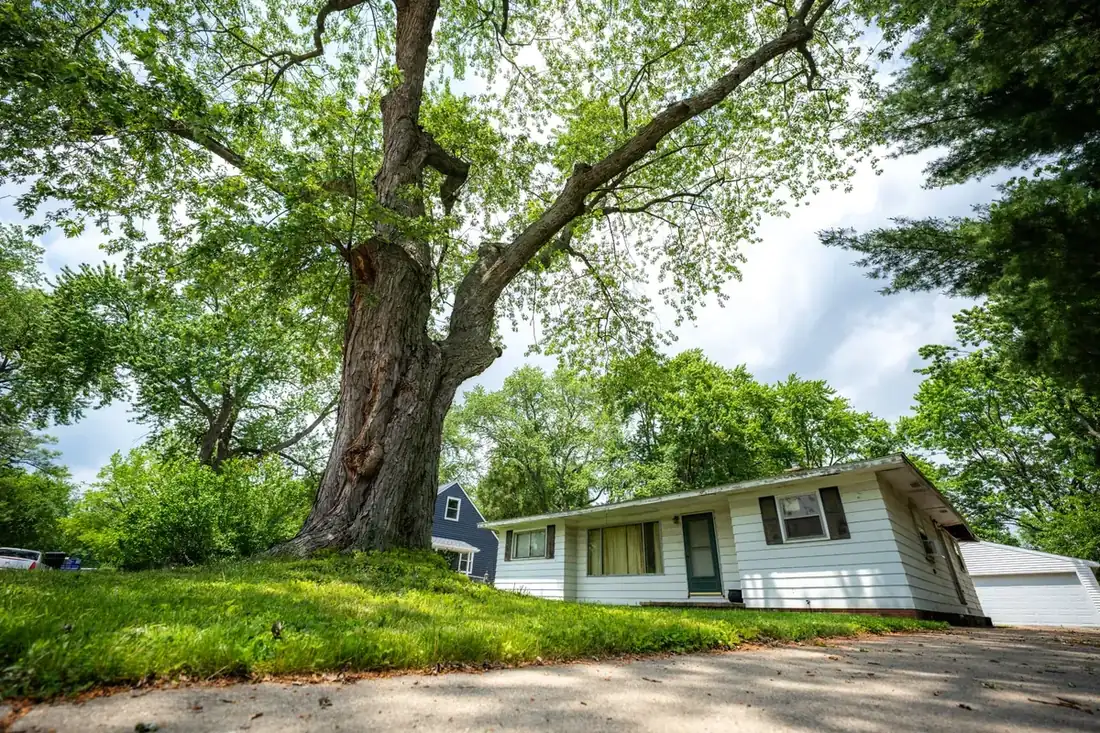
So the honest advice is this. If a tree over your roof has a crack, a dead limb, a split trunk, or fungus at the base, the weight of a January ice storm is the test it is going to be given. Passing that test is not something you want to leave to chance. Remove it, or have the hazard limbs taken off, while the ground is frozen and before the ice.
What to Look for After the Leaves Drop
Late October through November is when the inspection happens. Walk the property once the canopy is bare and look for the defects the International Society of Arboriculture lists as the main risk indicators.
Dead branches inside the crown are the most obvious (here is how to tell if a tree is dead). Look for cracks or splits running along the trunk or a major limb. Look for mushrooms or shelf fungus on the trunk or at the base — decay you can see on the outside means more on the inside. Check the big forks for a tight V shape with bark pinched between the stems; that is included bark, and it is the union most likely to split under load. Look for a new lean, or cracks and heaving in the soil on the side opposite the lean, which means the roots are moving.
Any one of those on a tree that can reach the house, the garage, or a neighbor's property deserves a professional look. The estimate is free, and if the answer is 'it can wait,' that is what we will tell you.
The Scheduling and the Price
Tree work is seasonal, and winter is the slow season across the industry. That is why the removal you book for January gets scheduled faster than the one you call about in June after a storm, when every company in Wayne County is running on emergency calls.
Consumer sources like Angi report that late winter is generally the least expensive time of year to have a tree removed, and that off-season trimming can run meaningfully less than peak-season work. Our pricing is based on the job — the size of the tree, where it is, and what it takes to get it out — but a job that takes fewer hours because the ground is frozen and the crew is not protecting a lawn is a job that costs less to do.
The practical version: get the estimate in the fall, get on the winter calendar, and the work happens on a clear cold day between the snow.
What Winter Is Not Good For
Planting. Wait for spring, when the soil warms up and dries out. Michigan State's horticulture faculty recommend spring planting for our region anyway.
Stump grinding on deeply frozen ground. It can be done, and we do it, but frost-hardened soil and stump fibers chew up grinder teeth and slow the work. If the stump can wait for a thaw, it usually should. If it is coming out with the tree in one visit, we plan for it.
Ice-loaded days. When branches are coated, nobody should be under them, including us. We wait for the melt, then clear the damage.
Dormant oil sprays for overwintering scale and mites need a 24-hour window above freezing, ideally above 40°F, so those go on the calendar for a mild stretch in late winter rather than a deep freeze.
Two Winter Jobs You Can Do Yourself
Scrape spongy moth egg masses. They look like tan, fuzzy patches about an inch and a half long on bark, fences, firewood and lawn furniture, and each one holds hundreds of eggs. Any time from mid-October to mid-April, scrape them into a container of soapy water and leave them for two days. Do not just scrape them onto the ground — the eggs survive. Oakland County runs a moth hotline through MSU Extension at (248) 858-0887.
Keep your firewood local. Michigan's guidance is not to move untreated firewood more than about 10 miles. More than 140 pests and diseases travel in firewood, which is how emerald ash borer got everywhere in the first place. If we drop wood for you, burn it at home.
Get on the Winter Calendar
If there is a tree you have been watching — an oak that needs shaping, a silver maple leaning toward the garage, an ash that died three summers ago and is now brittle — fall is when to call. We will look at it, tell you honestly whether it needs to come down, and if it does, put it on the schedule for the frozen months when it is safest, cleanest, and easiest on your yard.
Free estimates across Livonia and all of Southeast Michigan. Call (734) 788-8822.
— Related Services —
— Keep Reading —