Clearing a Wooded Lot Before Building in Michigan: Steps and Decisions
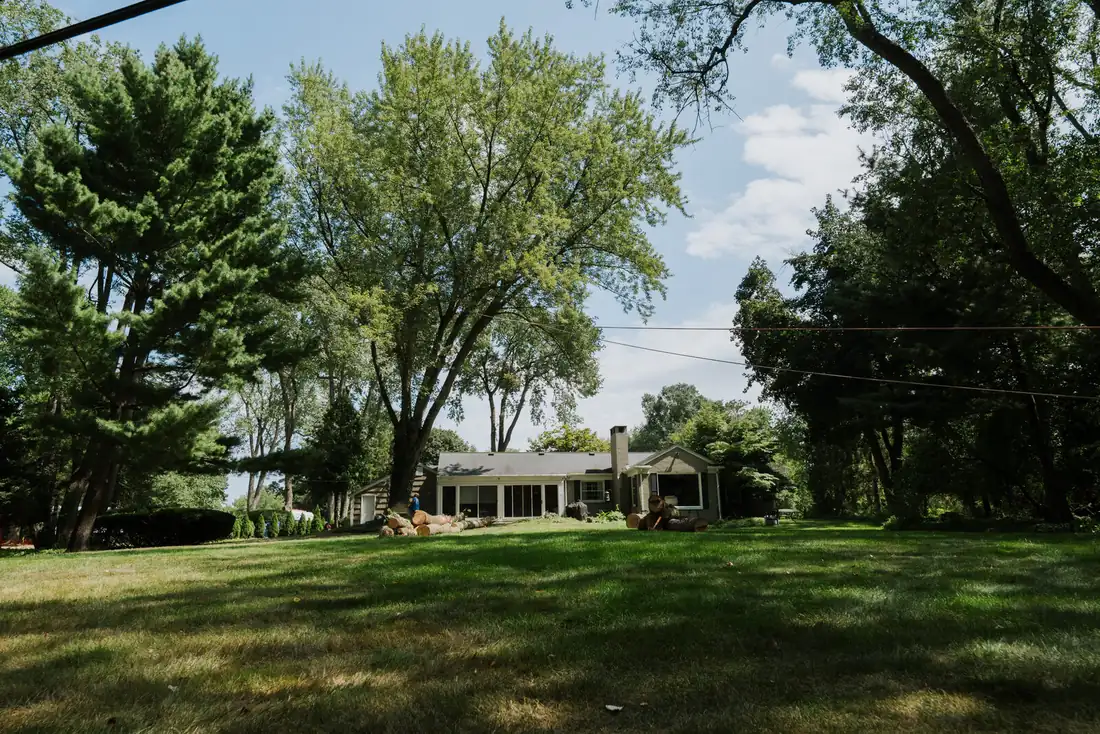
Buying a wooded lot out past the subdivisions is one of the better decisions you can make in Southeast Michigan. The trees are the reason the lot felt right. They are also the first thing standing between you and a foundation. Clearing a building site is not the same job as taking down a tree in a back yard. There are permits that have nothing to do with trees, soil rules that kick in before anyone touches a shovel, trees worth saving that can be killed by a truck parked in the wrong spot, and a timing calendar set by oak wilt and frozen ground. Here is the order we would do it in, and who does what.
— Quick Points —
- Under Michigan's Part 91 rules, an earth change of one acre or more, or any earth change within 500 feet of a lake or stream, generally needs a soil erosion permit before work starts.
- Trees you plan to keep need a fenced protection zone before the first machine arrives. Purdue Extension recommends about 1.5 feet of radius for every inch of trunk diameter.
- Stumps under a house, garage, or driveway footprint usually get pulled out whole by the excavator. Stumps in the yard can simply be ground.
Start With the Survey and the Stakes
Nothing gets cut until you know exactly where the house is going. That sounds obvious, but a lot of clearing jobs go sideways because someone eyeballed the footprint from the road. Get the property surveyed, get the house, garage, driveway, well, and septic field staked on the ground, and get the grading plan from your builder if one exists.
The septic and well locations matter as much as the house. On rural-edge lots in Livingston, Washtenaw, and northern Oakland counties, a lot of homes are on private wells and septic systems, and the county health department sets where those can go. Clearing a drain field area late, after the trees around it are already gone or damaged, is how people lose trees they meant to keep.
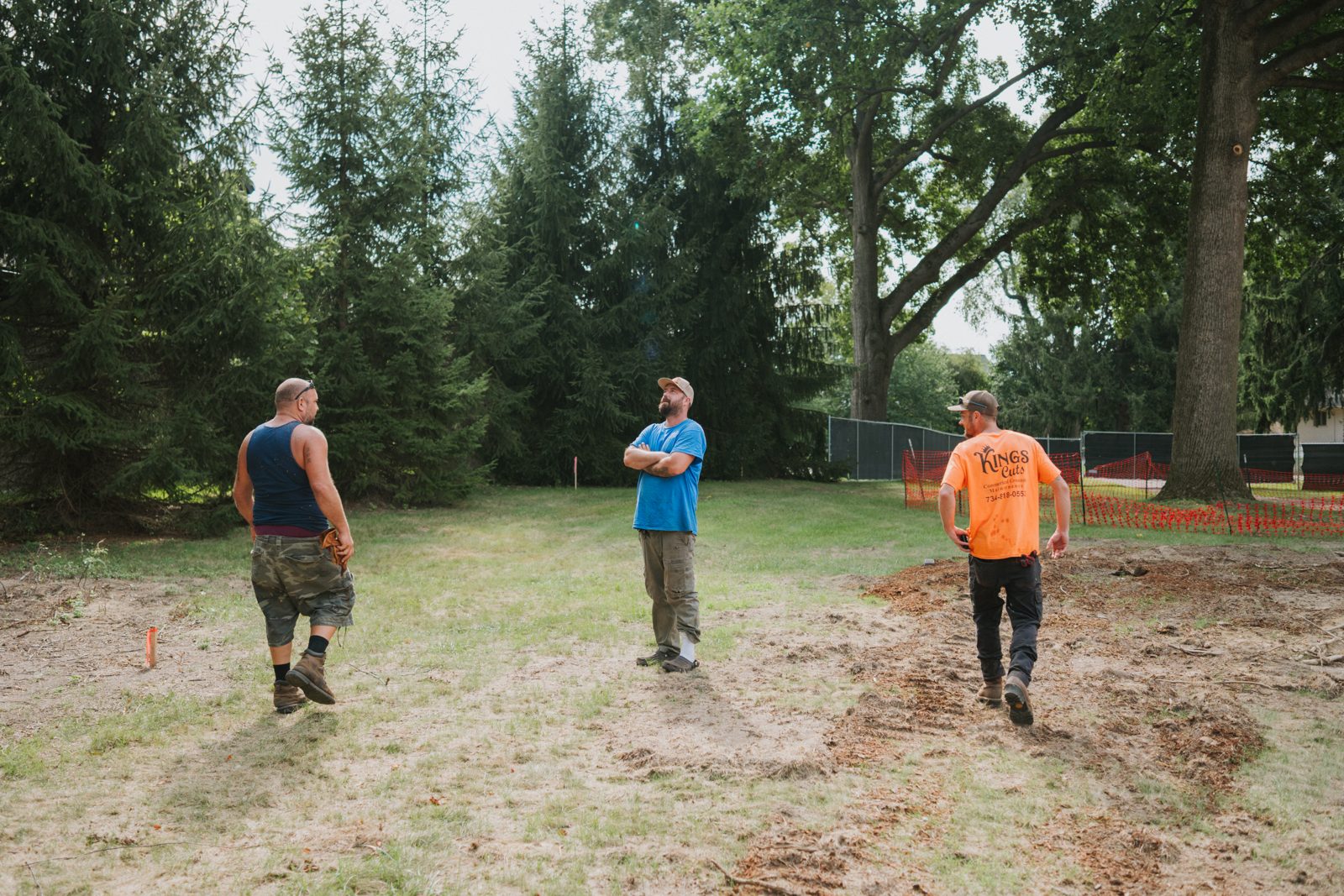
Once the stakes are in, walk the lot with your builder, your excavator, and whoever is doing the tree work. That one walk settles most of the arguments that come later: where the driveway enters, where materials get stockpiled, where the trucks turn around, and which trees stay.
Decide Which Trees to Save, and Mean It
Every wooded lot owner wants to keep as many trees as possible. The honest version is that you should keep fewer trees and protect them properly, rather than keep a lot of trees and watch half of them decline over the next five years.
Purdue Extension's guidance on protecting trees during construction is blunt about this. Preservation decisions should weigh species, size, condition, and location, and older trees growing in wooded areas are more sensitive to changes around them. A tree that grew up shoulder to shoulder with others is suddenly exposed to wind and sun when its neighbors are cleared, and it is standing on roots that were never meant to carry a bulldozer.
Good candidates to save are healthy, well-shaped trees at the edge of the work zone, not trees sitting ten feet from the foundation wall. A big oak right next to the basement dig will have a large share of its roots cut, and it may take years to die. The same Purdue publication notes that construction damage can take years to show up, which is why people are surprised when a tree that looked fine at the closing starts dropping limbs three summers later.
The trees you keep need a protection zone. Purdue recommends a radius of 1.5 feet from the trunk for every inch of trunk diameter, fenced with sturdy construction fencing or snow fence, with signs on it. Inside that fence there is no parking, no stockpiled dirt or block, no washing out concrete trucks, and no trenching. As little as 2 inches of fill soil over the root zone can potentially kill a tree. We cover root zones in more detail in our post on landscaping around trees.
Tree Ordinances Apply to Empty Lots Too
Many Southeast Michigan cities and townships regulate tree removal on land being developed, even when the same trees could be cut freely on an existing homesite. Novi is a clear example. The city protects trees 8 inches in diameter or larger inside its mapped regulated woodlands, and trees 36 inches or larger outside them. Protected trees can still come down, but the city requires replacement trees, up to four per tree removed, or a payment into its tree fund.
Other communities have their own versions, and some tie tree removal to the site plan or building permit review. Before anyone cuts, call the building or planning department and ask whether a tree or woodland permit applies to your parcel. Our post on tree removal permits in Southeast Michigan walks through what to ask.
The Soil Erosion Permit Nobody Expects
This is the permit that catches first-time lot owners. Michigan's Soil Erosion and Sedimentation Control program, under Part 91 of the state's environmental code, generally requires a permit for any earth change that disturbs one acre or more, or that is within 500 feet of a lake or stream. EGLE oversees the program, but the permits themselves are usually issued by a county enforcing agency or, in some places, by a city, village, or township that has adopted its own ordinance.
Cutting trees and leaving the stumps is not always treated the same as grubbing stumps and grading, so ask the enforcing agency for your county how they treat your plan. On a lot near one of the many small lakes and streams in Livingston and western Oakland counties, the 500-foot rule can apply even to a small clearing. Silt fence and other controls usually have to be in place before the ground is disturbed, and your excavator or builder is often the one who pulls the permit. Confirm who is responsible in writing.
Wetlands: Find Out Before You Clear
Low, wet corners are common on wooded lots here, and some of them are regulated wetlands. Michigan's wetland rules, administered by EGLE under Part 303, require a permit to place fill, drain surface water, build, or dredge or remove soil in a regulated wetland. EGLE's own examples of removal include pulling tree stumps. That means grubbing stumps or pushing fill into a wet area can become a permit issue even if cutting the trees above it seemed harmless.
If you are unsure, EGLE runs a Wetland Identification Program where state staff will review a site and flag wetland boundaries, with a three-year guarantee on the determination. A private wetland consultant can also delineate the boundary. Either way, get the answer before the equipment shows up. Fixing unpermitted work in a wetland is a much bigger project than asking the question.
Timing: Oaks, Frozen Ground, and Nesting Season
If the lot has oaks, and most wooded lots in this part of the state do, the calendar matters. The Michigan DNR advises against pruning or wounding oaks from April 15 through July 15, when sap-feeding beetles can carry the oak wilt fungus to fresh wounds. Clearing next to oaks you plan to keep means bark gets scraped and limbs get broken. Doing that in May puts the trees you are saving at real risk. The DNR says the best time for oak work is winter, when trees are dormant.
Winter has other advantages for clearing. Frozen ground carries heavy equipment with less rutting and less compaction around the trees you are keeping, and wet spots that are impassable in April can be workable in January. The tradeoff is that stump excavation and grading usually wait for the ground to thaw, so plan the cutting for winter and the dirt work for spring.
As general guidance, many landowners also try to avoid heavy clearing during the spring and early summer bird nesting season. It is one more reason winter clearing tends to make sense.
Felling, Forestry Mulching, and Hauling
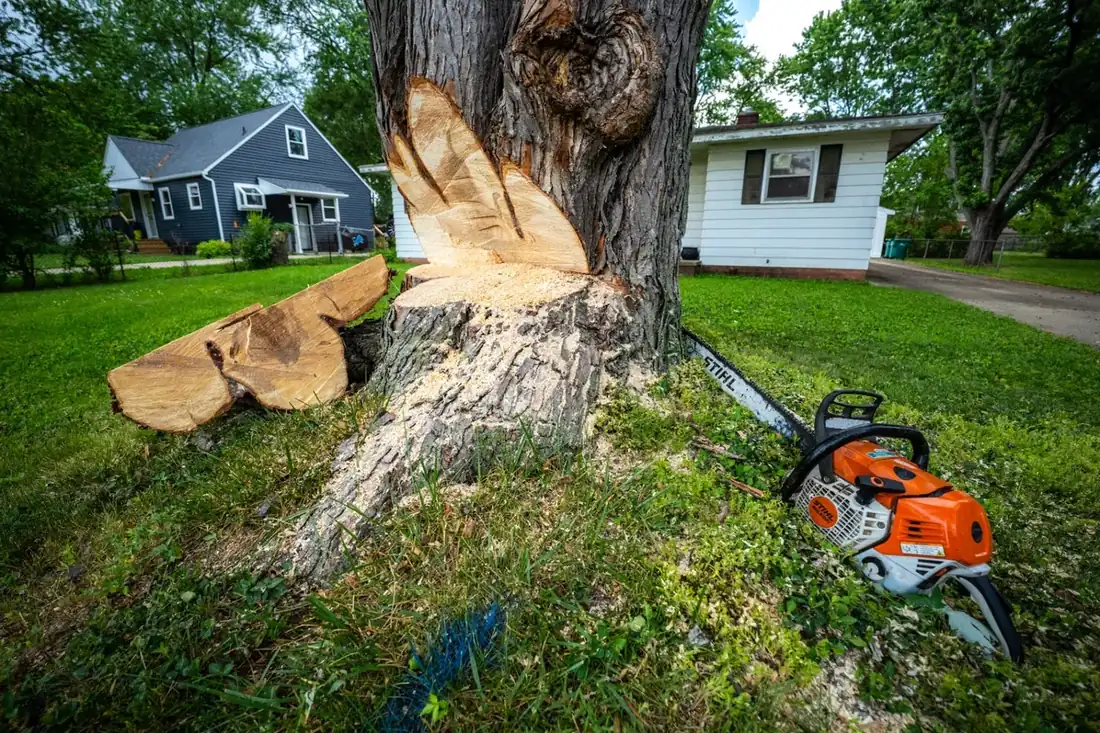
There are a few ways the trees and brush actually come off the lot. Conventional felling means cutting trees, bucking the logs, chipping the brush, and hauling it away or leaving firewood stacked where you want it. It is the right approach for large trees, trees near anything you care about, and any tree that needs to come down in a controlled direction.
Forestry mulching uses a machine that grinds standing brush and small trees into a mulch layer on the ground. It is fast for thick understory, buckthorn, and small saplings, and it leaves the soil covered. It is not a substitute for felling mature trees, and a thick mulch layer is not what you want under a foundation or driveway, where the excavator will be stripping to mineral soil anyway.
On most building lots the answer is a mix: fell and remove the big trees in the footprint and the driveway, mulch or clear the understory where you want sightlines or lawn, and leave the protected trees and their fenced zones alone.
Stumps: Grind or Pull Depending on What Goes on Top
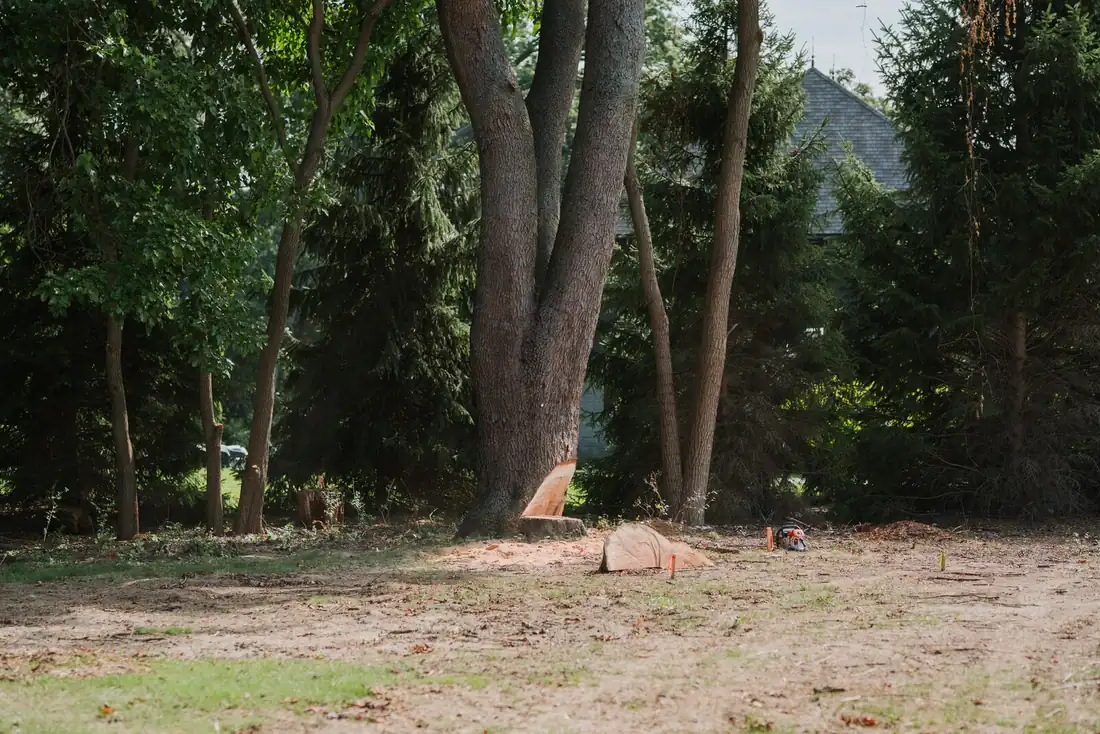
Where the stump sits determines what happens to it. Under a house, garage, porch, or driveway, stumps are usually excavated, meaning pulled out root ball and all, because buried wood decomposes and leaves soft spots under whatever was built on top. That work is typically done by the excavator as part of digging the basement and preparing the subgrade.
In areas that will be lawn, garden, or left wooded, stump grinding is usually the cleaner option. It grinds the stump below grade without tearing up a big hole, and the grindings can be raked out and replaced with topsoil. We cover the tradeoffs in our post on stump grinding vs. leaving a stump. Any digging, including stump grinding and excavation, requires a MISS DIG 811 notice at least three business days ahead under Michigan law. The service is free.
What It Costs, in Published Ranges
Every lot is different, so treat published numbers as a rough starting point, not a quote. Angi's cost guide for the Detroit area lists land clearing at roughly $900 to $5,400 per acre, with lightly wooded land at the low end and densely forested land at the high end, and an average project around $5,400. The same guide lists tree removal at roughly $250 to $1,500 per tree and forestry mulching at roughly $400 to $1,500.
What moves the price is density, tree size, access, how much has to be hauled versus left on site, how many trees need careful removal around the ones you are keeping, and whether stumps are ground or excavated. Permits, surveys, and wetland work are separate costs that are easy to forget in the budget.
What We Do and What the Excavator Does
It helps to know where the handoff is. Our crew handles land clearing, tree removal, stump grinding, brush and debris removal, and demolition of old sheds, decks, and fences that are often sitting on older rural parcels. We can take down the trees in the footprint and driveway, clear understory, and grind stumps in areas that will not be built on.
The excavator handles stump pulling under the building footprint, stripping topsoil, digging the basement, grading, and usually the soil erosion controls. Your builder coordinates both. Getting the trees down first, with the protection fencing already up, gives the excavator a clean site and keeps the trees you paid for standing.
Planning a Build on a Wooded Lot?
Get the survey stakes in, confirm the permits, and then have us walk the lot with you. We will tell you which trees are realistic to keep, what should come down, and how to sequence the work around oak season and frozen ground. Free estimates across Livonia and all of Southeast Michigan. Call (734) 788-8822.
— Related Services —
— Keep Reading —